

GCSE Handbook 2026
Explore this section
Welcome to Key Stage 4
Our GCSE Handbook allows you to understand how we as a school operate in regard to Key Stage 4 and the all important GCSE examinations at the end of Year 11. This handbook will provide you with all the necessary information regarding GCSE options, our academic processes, and career pathway support.
Subject Option Process
In Key Stage 4 all pupils study English, Maths and Science to GCSE level. In addition, all pupils participate in PE and games and have PSHCE lessons.
To complete the timetable, students must select four further subjects, one from each block shown below.
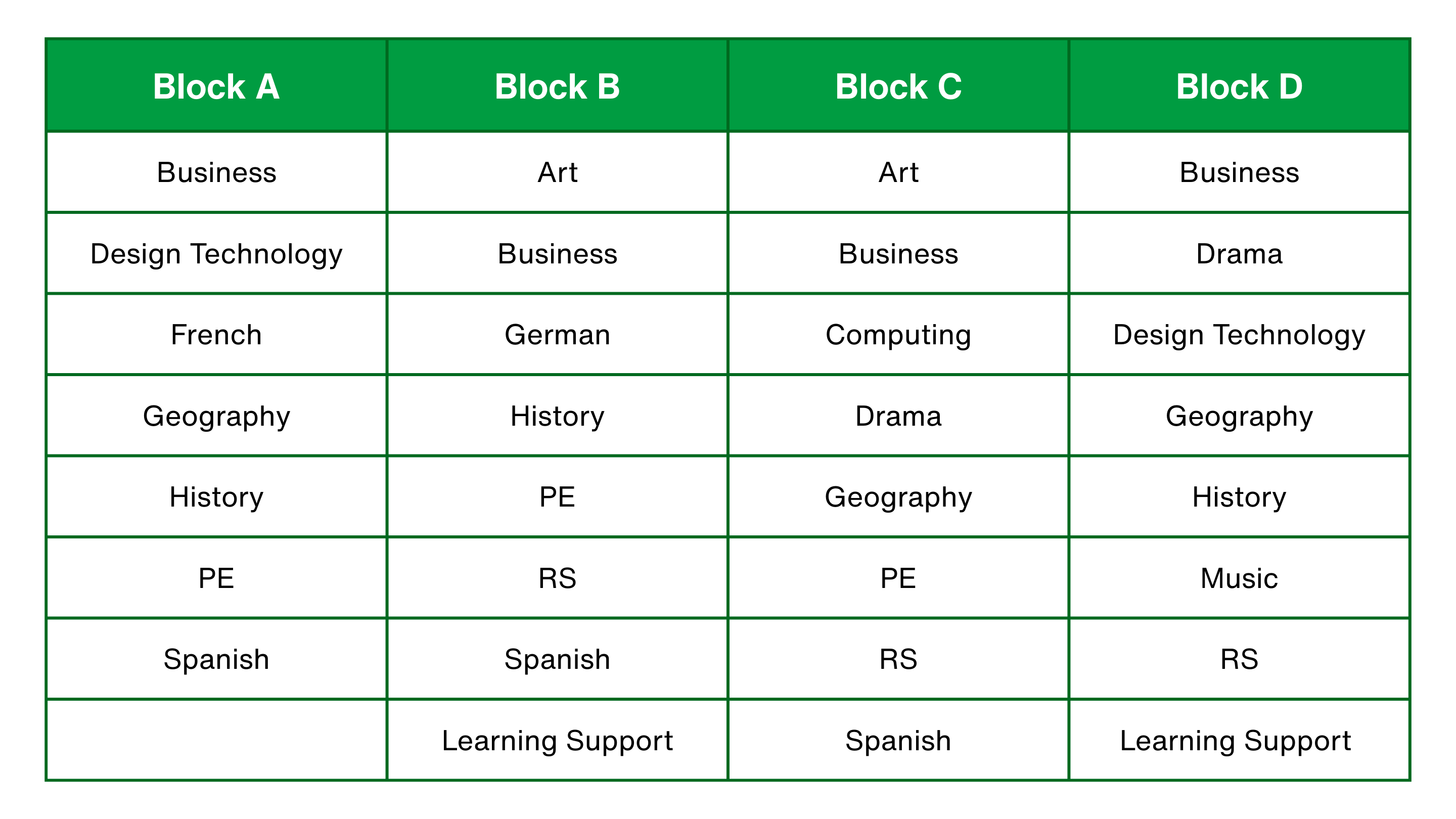
All pupils, apart from those attending the Learning Support Unit or taking ESOL, are recommended to choose at least one modern foreign language. Particular thought should be given to new subjects that can have a superficial appeal as they have not been studied before!
PE is inevitably popular, possibly because of its practical nature. However, PE will involve a good deal of extra-curricular commitment so a decision to take this needs careful consideration. PE also entails appropriate academic study to balance the practical aspect, and attention needs to be paid to the details herein. In order to successfully study PE, students must be a member of at least one school sports team per term.
Changes to GCSE Grading
Over the last few years all GCSEs have been ‘reformed’ with grading now from 9 to 1 instead of from A* to G. Most GCSEs are examined at the end of the course; any coursework takes the form of ‘Non-Examination Assessments’ which are completed in class under staff supervision, in some cases following strict examination rules.
Academic and Pastoral Monitoring
Academic monitoring is carried out in the first place by the subject teachers and Heads of each Department. The Heads of Year are kept informed of all progress and have detailed knowledge of the achievements of every child in this area of the school. Pastoral and disciplinary matters are also the concern of the Heads of Year and Pastoral Support Lead. Any parent who wishes to discuss his or her child should, in the first instance, contact the Head of Year.
Attendance Details
Absence or Leave
Any request for leave from school should be addressed to the Headmaster. If a pupil is absent from school through illness, then we ask the parents to inform the school by telephone immediately and follow this up with a letter to the form teacher on a pupil’s return to school. In the case of a protracted absence, please contact the Head of Year.
Late for School
Those pupils who arrive late should report to reception in the Sports Centre.
Post-16 Provisions
Work Experience
The school provides an opportunity for members of Year 11 to take part in a work experience scheme, on an individualised basis, after they have completed their GCSE examinations.
Entry into Sixth Form
From the summer of Year 10 and throughout Year 11, the school will provide advice and support to the pupils as they make plans for their next steps. Advanced level pupils at the school are required to have a minimum of five GCSEs at grade 4 or above.
Most departments will require at least a grade 6 if their subject is to be taken at A-level. It is our firm expectation, however, that pupils will stay on to the Sixth Form and complete their secondary education here at The Grove.
In the Sixth Form, pupils are appropriately prepared for university and/or apprenticeships. Click HERE to access the Sixth Form Digital Handbook for 2026.
Careers
Pupils will have the opportunity to gain exposure to a range of careers pathways, develop their ‘soft skills’ and make informed choices about their post-16 and post-18 options. Towards the end of Year 10, all students have a 1:1 post-16 interview with a senior member of staff to explore their options moving forward. This is then repeated in the Autumn term of Year 11 where they also have a range of other experiences to help them prepare for life after GCSEs.
‘Futures Friday’, which takes place during a form period every other week, consists of structured and progressive activities that students can access to help them make more informed decisions about their future study and careers options.
Globalbridge
These sessions also allow students to access a digital platform called Globalbridge. Globalbridge is a digital learner profile that enables students to record and showcase their talents, skills and qualifications through an interactive, media rich, secure online profile.
Super-Curricular Programme
Other activities for students to access throughout the academic year are found through the ‘Super-Curricular’ programme. The Super-Curricular Programme has the aim to develop students from Year 10 upwards so they can gain a broader range of experiences and opportunities outside of the classroom. This is so they can make a more informed decision about their post-16 and post-18 future whilst developing important soft skills. Opportunities are offered through workshops/seminars, competitions, lectures, MOOCS, Ted Talks and work experience.
A wide range of careers resources are freely available to pupils under the Careers section on Firefly.
Bring Your Own Device (BYOD) Programme
The information below provides answers to common questions and explains why the Bring Your Own Device (BYOD) programme is important for our Year 9 students and above.
Why does the school have BYOD for Year 9 and above?
The BYOD initiative helps students develop essential digital skills for modern learning and future careers. Students can take notes, access resources, complete assignments, and collaborate effectively, while learning to keep themselves safe online and to be discerning and critical users of materials and AI.
What will students use their devices for?
Devices will be used for researching topics, creating presentations, submitting homework, participating in interactive lessons, using educational apps, and completing coursework.
How will the school support students and parents?
Students will attend an induction session to learn how to connect to the school network, use required software, manage their device, and print from it. Parents can contact the school for advice.
What software will students need?
All students have free access to Office 365, including Word, Excel, PowerPoint, OneNote, and Teams. These apps can be downloaded for free. This is a Woodhouse Grove School owned licence. The family is responsible for ensuring that the computer has appropriate security and malware software. Parents may wish to consider software for parental control and monitoring on their child’s device.
What type of device is suitable?
Recommended features:
- Physical keyboard
- Lightweight
- Long battery life
- Ability to run necessary apps
- Protective case
- 8GB memory ideal (4GB sufficient)
- Windows/Chrome/MacOS acceptable
- Tablet + keyboard + stylus acceptable
- Headphones for multimedia
What rules apply to device use at school?
Students must use devices responsibly, follow internet policy, avoid distractions, and report technical issues. Students will be taught the importance of these guidelines and expected to sign a standard annual agreement about their conduct (Pupil IT User Agreement).
Students are expected to keep devices secure and arrive in school each morning with a fully-charged device. All students may utilise a locker; this should be kept locked when not in use.
Important: Device Insurance
Accidents can happen, and devices brought to school are at risk of accidental damage. A high-spec device is not appropriate for school. The school cannot take financial responsibility for damaged or stolen devices. We strongly advise parents to consider suitable insurance for their child’s device. Protective cases and extended warranties are also recommended for peace of mind.
What if parents or students have questions?
The school welcomes questions and is happy to provide further information or support. Please contact us if you need advice about device selection, setup, or usage.
GCSE Subject Guides
Below is further information regarding our core curriculum and options subjects. Each section will highlight the requirements for each subject, assessment structures, and any extra costs associated with the subject.
Core Curriculum
English Language
Edexcel B
What will I study?
The IGCSE English language course builds upon skills and texts taught at key stage 3. It aims to extend students’ knowledge by broadening and deepening skills; for example, students develop the ability to:
• Read and respond to materials from a variety of sources.
• Make comparisons between texts and analyse the ways in which writers achieve their effects
• Construct and convey meaning in written language, matching style to audience and purpose.
There are 3 units to study over the two year course.
Assessment: 100% examinations and a Spoken Language endorsement.
External examination (3hrs)
How will I be assessed?
External written examination (3 hours)
Section A: Short and long answer questions on 2 unseen non-fiction texts.
Section B: Directed writing – 1 task with focus on audience, form or purpose.
Section C: 1 writing task from a choice of 3 – discursive, narrative and descriptive
Spoken Language Endorsement
Candidates must demonstrate their presentation skills in a formal setting, listen and respond to questions and feedback, and use spoken English effectively.
The presentation may take a variety of forms, including:
a) a speech, followed by questions from an audience.
b) a formal debate, followed by questions from the audience.
The assessment will be internally set and assessed. No marks area awarded for the assessment, instead pupils achieve a grade of Pass, Merit or Distinction.
Super-Curricular Opportunities
• Poet Laureate Competition
• Poetry by Heart Competition
• Reading and Speaking Competition
• Theatre Trips
• Online lectures
English Literature
Edexcel IGCSE
What will I study?
This course allows pupils to experience a range of literature: both traditional and modern text, with focus on texts which have had a significant influence on our English heritage. All students will study English Literature alongside English Language, in order to experience the full breadth of English studies.
How will I be assessed?
There are 2 units to study over the two year course.
Component 1: Poetry and Modern Prose (60%)
Pupils will study two texts: an anthology of poetry on a range of topics and a modern novel. A copy of the poems will be provided for the first section of the exam; the modern novel is examined in a 'closed book' format.
Assessment: external examination (2 hours)
Pupils will study two texts: an anthology of poetry on a range of topics, and a modern novel.
Assessment takes the form of a written external examination which is 2 hours long. A copy of the poems will be provided for the first section of the exam; the modern novel is examined in a 'closed book' format.
Modern Drama and Literary Heritage Texts (40%)
Pupils will complete two assignments as coursework; one on a Shakespeare play or 19th century novel, and another on a modern play.
Assessment: internal assessment
Extra Costs
For all English courses, pupils buy their set books which they can then annotate. These books remain the property of the pupil at the end of the course. The cost of these books is charged to the school bill.
Mathematics
Edexcel IGCSE
What will I study?
The IGCSE Mathematics course begins at the start of Year 9 and builds directly upon the work studied by the pupils previously. It is a linear course assessed by two 2 hour terminal papers, both of which allow the use of a calculator. There is no controlled assessment.
The course is taught using traditional methods with a focus on the application and understanding of the mathematics required, alongside developing problem solving skills and mathematical reasoning. Pupils will have access to the latest web-based revision and homework resources to support their learning.
There are two entry levels:
Higher Tier (grades available 9-1)
Foundation Tier (grades available 5-1)
The large majority of our pupils are prepared for the higher tier exams, although a small number each year opt to take the foundation tier.
Students in set 1, along with motivated students in set 2, will also sit an additional maths qualification at the end of Year 11. This is currently the AQA Level 2 Certificate in Further Mathematics.
How will I be assessed?
AO1: Number and Algebra (60%)
AO2: Shape, Space, and Measures (25%)
AO3: Handling Data (15%)
Each two-hour examination is comprised of a paper marked out of 100.
Resources
It is vital that students are properly equipped for lessons and a suitable calculator is necessary in all maths lessons. When buying a new calculator, we recommend the fx-85GTCW or the fx-83GTCW. Pupils are expected to own standard geometrical instruments (ruler, proctractor, and pair of compasses).
All students will be issued with a CGP IGCSE textbook to use fofr the duration of the course. They will use this book and other materials in-lesson and for homework.
Super-Curricular Opportunities
• UKMT Maths Challenge
• Assisting in Maths Roadshows for younger students
Science (Double Award)
Edexcel IGCSE – Coordinated Science
Syllabus code 4SD0
Qualifications: Double Award Science
What will I study?
In September, all Year 9 pupils start studying IGCSE Science. All sets cover the same material in the build-up to internal examinations in the summer term. They are initially set into three bands, which are based on their performance in the year 8 end of year exam, end of topic tests and professional judgement. Science IGCSEs are terminally assessed, with no re-sits of separate components allowed. They represent a rigorous and yet accessible course, which is assessed by examinations at the end of Year 11. There are no tiers of entry, and all students are prepared to access all the questions.
Our aim is to help pupils to achieve their full potential in science, gain the highest grades possible and, where possible, prepare them for study of science at a higher level. The students will be aware of the relevance of the content they are covering to their current and future lives.
In general, the aim of the course is to:
• Develop the pupils’ interest in, and enthusiasm for, science.
• Encourage pupils to develop a critical approach to scientific evidence, ethics, and methods.
• Develop the skills necessary to become a competent experimental scientist.
• Acquire scientific skills, knowledge and understanding necessary for progression and further learning.
• Equip pupils to make a successful transition to studying A-level sciences.
Pupils are in the same set for all three science subjects. There are six science sets in Years 9 to 11, with setting being done for the first time based on examination results at the end of Year 8 and progress throughout the year. Sets are based on achievement across all three sciences. Some pupils are transferred between sets at the end of the summer term in Year 9, and at the end of Year 10. Each of the three science subjects is taught by a subject specialist.
IGCSE Science requires pupils to be taught the theory which underpins meaningful experiments. The departments are well resourced so that, when possible, students can learn actively through investigation, taking ownership over their own activities. Students will carry out modelling activities where practical is not applicable. Pupils are exposed to a range of differentiated teaching methods and ICT is regularly used in the classroom. Students will have the opportunity to produce independent work with thorough guidance and will be given the opportunity to work collaboratively with peers. There is an expectation that all students will have access to a device every science lesson. This will be used to access Firefly tasks, carry out independent research, learning apps and engage in virtual lab work. Many students choose to curate their notes on a device and store these on OneDrive, sharing a link to their work with their class teacher. Literacy and numeracy skills are practised within most science lessons. Students of all abilities will experience challenge in their class and prep work.
Students are given a revision guide for which they can access an online version to support learning in the lesson and at home. Firefly resources are extensive, and we will be using these frequently and making every effort to minimise photocopying to meet schoolwide sustainability targets. Students may use their device to produce online notes which are monitored by teachers or use exercise books. Students will be expected to have pencils, rulers, protractors, compasses, pens, and calculators for each science lesson.
How will I be assessed?
Super-Curricular Opportunities
• British Biology Olympiad
• UK Chemistry Olympiad
• British Physics Olympiad
• GCSE Science Live
PSHCE
Our PSHCE and SMSC programme along with our shared values for Methodist education and broad curriculum complement and reinforce our aims to provide pupils with a broad knowledge and understanding of many issues. We try to ensure each individual develops the ability to deal with a variety of situations, moral and social dilemmas, develop skills, acquire knowledge and make informed choices and decisions so they grow into responsible citizens. Woodhouse Grove has a whole school approach to develop the qualities and attributes that pupils need to thrive as individuals, family members and members of society plus also encompassing a greater care for our wider world.
Pupils follow a series of lessons based around the National Curriculum Programmes of Study:
Health and Wellbeing
• How to handle transitions
• How to manage physical, mental, emotional, and sexual health and wellbeing
• Parenthood and Teenage Pregnancy
• STIs and safer sex
• How to manage risks and stay safe
• How to identify and access help
• Adminstering First Aid
• The role of media on lifestyle.
Relationships
• How to develop healthy relationships within a range of social and cultural contexts.
• How to recognise and manage our emotions
• Confidence around Consent
• Managing loss including bereavement, separation, and divorce
• How to respond to potentially negative relationships.
• How to respect equality and diversity
Living in the Wider World
• Our rights and responsibilities as members of a diverse society
• How to make informed choices in order to be enterprising and ambitious
• How to develop teamwork and leadership skills
• Careers, Post-16, and the world of work.
• The economic and business environment
• Personal Finances
• How to respect fundamental British Values.
These topics all provide opportunities for the pupil to grow and develop as individuals. They learn to work and discuss in groups and as a whole class unit thereby listening to other people’s opinions and learning to work together.
Where appropriate the use of outside speakers is incorporated into the programme.
PE and Games
Please note that this is not the GCSE PE option but the compulsory PE and Games pupils take part in during Key Stage 4.
Our aim is to inspire lifelong engagement and participation in sport for all pupils – and develop an understanding of the importance of exercise and physical activity in contemporary lifestyles, irrespective of ability. We continue to challenge and develop experience and expertise in a number of activity areas, to challenge all pupils to be the best versions of themselves and strive for representative successes.
Pupils are timetabled for 2 x 55 minute (single) periods of PE every two weeks and a 1 x 110 minute (double) Games lesson each week.
PE
On a practical level, students can select a pathway that they think is best suited to them. There is a choice of 4 pathways for students to choose. Activities on these pathways include football, athletic development, table-tennis, netball, basketball, squash, volleyball, yoga, badminton, cricket, tennis, athletics and swimming.
Teaching Methods
The focus of the curriculum is to develop knowledge and understanding through a variety of activity areas. The learning outcomes change for the different activity types but include:
• Developing and refining advanced skills and techniques.
• Evaluate and improve performance levels
• Use of tactics and strategies within game situations
• Developing the use of theoretical knowledge and terminology.
Games
Autumn Term: Rugby and Netball
Spring Term: Rugby Sevens, Netball, and Football
Summer Term: Athletics, Cricket, and Tennis
We also offer competitive fixtures in Badminton, Basketball, Cross-Country, Fencing, Hockey, Swimming, Squash, Table Tennis, and Triathlon.
Teaching Methods
Our major sports practices take place during Games lessons, these are teacher led, pupils are challenged to continuously develop their individual and team skills, with the overall aim to increase performance. Every lesson has a competitive element in it and pupils are continuously challenged to develop not only their fitness levels but also their tactical knowledge and understanding of the sport in preparation for competitive fixtures which take place mid-week and on weekends.
The sports carousel option has been designed to be pupil led, we challenge the pupils to develop and refine skills and techniques in a wide range of activities. It provides pupils with an opportunity to improve their fitness levels and enhance their mental wellbeing.
Option Subjects
Art and Design
ExEduqas (WJEC)
Portfolio of Work 60%
Externally set task 40%
What will I study?
GCSE Art & Design encourages pupils to develop:
• creative and imaginative powers, coupled with practical skills for communicating and expressing ideas, feeling and meanings in art, craft and design.
• investigative, analytical, experimental and interpretive capabilities, aesthetic understanding and critical skills.
• understanding of codes and conventions of art, craft and design and awareness of contexts in which they appear.
• knowledge and understanding of art, craft and design in contemporary societies and in other times and cultures.
Pupils will follow the art, craft and design specification; this allows them to explore all areas of the subject and allows individuals to work in any medium and in any style of their choosing. It also allows pupils to use all the skills and experiences gained from Years 7 through to 9 in their approach to the making of practical work.
How will I be assessed?
Portfolio of Work (60%)
The portfolio will contain selected elements of the candidate's work from both years of the course. The selected works will reflect the breadth and quality of their study, but must include work from more than one project.
Externally set task (40%)
Component 2 is set by the exam board; the paper is issued on the 1st of January in the exam year. Pupils have twelve weeks of preparation time to respond to one of the fifteen set themes or questions. The examination then takes place in the art department for 10 hours over two days, completed under exam conditions.
ASSESSMENT OBJECTIVES
Each of the four assessment objectives carry equal weighting and are each 25% of the final mark. Both the portfolio and the externally set task must address all four of the criteria.
1. Develop their ideas through critical understanding of sources.
2. Refine work by exploring ideas, selecting and experimenting with appropriate media, materials, techniques and processes.
3. Record ideas, observations and insights relevant to their intentions as work progresses.
4. Present a personal and meaningful response, that realises intentions and demonstrates understanding of visual language.
Work Journals and Preparation
Underpinning all practical enterprise for GCSE Art & Design is the sketch book. This journal presents evidence of work in all the assessment objectives and shows how ideas and skills have developed through time. Pupils may also use design sheets to present their preparatory work. These documents should be included in both their portfolio and as evidence in the externally set task.
Super-Curricular Opportunities
Students will be invited to the Year 10 trip to the Hepworth Gallery in Wakefield. There are also many online resources that can be explored, and additional art courses at local providers.
Extra Costs
Art & Design GCSE makes good use of many different materials. To offset some of the costs involved, pupils who opt for art will be charged £20 for the autumn and spring terms only. Any pupil who makes particularly large work in either 2D or 3D will be expected to make a further contribution to the cost of their materials.
Business Studies
Edexcel
Syllabus 1BS0
What will I study?
This course covers all areas of business and is, therefore, a very useful addition to any future career. The vast majority of our students will work within a business setting at some stage of their lives and this course will give them a valuable insight into the business world. Students will develop their understanding of a range of business concepts, terminology, business objectives, the integrated nature of business activity and the impact of business on individuals and the wider society.
They will apply this knowledge to contemporary business issues and to different types of businesses in local, national and global contexts. Students should expect to develop as enterprising individuals with an ability to think commercially and creatively, allowing them to solve problems, making informed and fully justified business decisions.
In Year 10, students will concentrate on the key business concepts, issues and skills involved in starting and running a small business. Students will develop an understanding of the interdependent nature of business activity through learning about the interactions between business operations, finance, marketing and human resources, as well as the relationship between the business and the environment in which it operates.
It provides a framework for students to explore core concepts through the lens of an entrepreneur setting up a business. They will cover areas such as enterprise and entrepreneurship, how to spot a business opportunity, how to put a business idea into practice, how to make a business effective and develop an understanding of the external influences on business.
In Year 11, students will examine how a business develops beyond the start-up phase. They will focus on the key business concepts, issues and decisions used to grow a business, with emphasis on aspects of marketing, operations, finance and human resources. Students will also consider the impact of the wider world on the decisions a business makes as it grows. They will be introduced to national and global business contexts and will develop an understanding of how these contexts impact business behaviour and decisions. The 5 key topics this year comprise of understanding business growth, making marketing decisions, making operational decision, making financial decisions and making human resource decisions.
All teachers who deliver this course have worked in industry prior to their teaching careers and often draw upon this experience to bring the specification to life. Throughout the year, a range of industry specialists are invited into school to work with our students in order to support theoretical teaching.
Business Studies is a highly regarded GCSE qualification; it combines well with most subjects and provides a good grounding for A-level Business and A-level Economics as well as A-level Computing.
How will I be assessed?
Two exams – both sat at the end of Year 11.
Exam 1: Investigating Small Business (50%)
Based on Year 10 content. Questions will comprise of a combination of compulsory multiple-choice, short and extended answer, data response and scenario-based questions with a total of 90 marks: 1 hour 45 minutes. Some of the questions will be based on business contexts given in the paper.
Exam 2: Building a Business (50%)
As above but focusing on the Year 11 content.
Super-Curricular Opportunities
Students are able to take part in LEAP: an enterprise, team-based competition.
Computer Science
OCR
Specification GCSE (9-1) Computer Science J277
What will I study?
Introduction
Computer Science is the study of how computer systems work and how they are constructed and programmed. It explores a set of techniques for solving problems and requires logical thinking to be developed to understand programming. These are some of the valuable transferable skills the specification is designed to cover.
Practical Programming
Students are given the opportunity to undertake programming tasks during the course which allows them to develop their skills to design, write, test and refine programs using a high-level programming language like Python. Students will be assessed on these skills during the written examinations.
Flipped Learning
Theory lessons frequently incorporate a flipped classroom approach, using the Cornell University note-taking method and developing skills useful for both A-level and University study.
Although it is preferable that those wishing to take this course have completed the Year 9 computing option, entry is not restricted to these students. The subject matter is suited to all those who enjoy logic puzzles and problem solving.
As well as developing some valuable skills, this course could lead directly to an A-level in Computer Science or would be a good foundation for a broad range of A-levels and courses at university.
Career Options
Having programming and other technical computer skills opens up a wide variety of career opportunities for students. All industry sectors need people with programming skills to create applications for them. In particular, the video games industry needs more people with programming skills to create the next generation of games in this lucrative field. As more people depend on their smartphones, creating apps is also likely to be a big growth area requiring programming skills.
How will I be assessed?
Component 01: Computer systems
Written examination: 1 hour 30 minutes
50% of the qualification (80 marks available)
This component introduces students to:
• The central processing unit (CPU)
• Computer memory and storage,
• Data representation,
• Wired and wireless networks
• Network topologies
• System security and system software.
• It also looks at the ethical, legal, cultural and environmental concerns associated with computer science.
Component 02: Computational thinking, algorithms and programming
Written examination: 1 hour 30 minutes
50% of the qualification (80 marks available)
Students apply their knowledge and understanding gained in Component 01, developing skills and understanding in computational thinking.
This includes:
• Algorithms
• Programming techniques
• Producing robust programs
• Computational logic and translators.
Super-Curricular Opportunities
• Learn Python in 100 days (online course)
• Coding Club
• Follow computer science podcasts
Design and Technology
AQA
Syllabus 8552 - Design & Technology
What will I study?
Students will undertake a design and make project as part of their GCSE assessment. All research and development work is recorded using an appropriate means of presentation including sketches, CAD, written notes, modelling and formal drawings to create a Design Folder which alongside their final practical outcome forms the non-exam assessment (NEA) for the course (50% of GCSE). This will commence in the June of Year 10.
In addition to the design and realisation of ideas in the non-exam assessment (NEA) project, pupils will develop a working knowledge of technical principles which will be examined at the end of the course (50% of the GCSE).
Core technical principles
• New and emerging technologies
• Energy storage and generation
• Modern and smart materials
• Systems approach to designing
• Mechanical devices
• Materials and their working properties
Specialist technical principles
• Selection of materials and components
• Forces and stresses
• Ecological and social footprint
• Scales of production
• Sources and origins
• Using and working with materials
• Stock forms, types and sizes
• Specialist techniques
• Surface treatments and finishes
Designing and making principles
• Investigation, primary and secondary data
• Environment, social and economic challenge
• The work of others
• Design strategies
• Communication of design ideas
• Prototype development
• Selection of materials and components
• Tolerances
• Material management
• Tools and equipment
• Techniques and processes
How will I be assessed?
The GCSE therefore consists of a written paper and a non-exam assessment (NEA). These components are weighted as follows:
UNIT 1: Written paper. 50% of total GCSE (2 hours)
UNIT 2: Non-exam assessment. 50% of total GCSE (30-35 hours)
Extra Costs
The cost of the materials used by individual pupils will be charged to their account at the end of each term; this will vary on the size/complexity and type of materials that are selected by the pupils.
Super-Curricular Opportunities
Year 10 students have the opportunity to visit a local manufacturing plant as part of the annual Bradford Manufacturing Week. Year 11 students keen on careers in engineering are encouraged to apply for Arkwright Scholarships.
Drama
Eduqas (WJEC)
What will I study? In addition to the creative and academic challenge provided by the GCSE drama course, this subject allows students to develop key transferable skills, such as critical thinking, evaluation, collaboration, communication and can build confidence and resilience.
In taking GCSE drama, students who enjoy creating and watching theatre performances can broaden their knowledge and understanding of this creative subject. Throughout the course, students can be assessed as either a performer or as a designer, meaning that students who enjoy the subject but don’t enjoy performing may still flourish.
How will I be assessed?
Component 1: Devising Theatre (40% of qualification)
Internally assessed, externally moderated.
Pupils will be assessed as a performer or as a designer. Pupils participate in the creation, development and realisation of a piece of devised theatre using either the techniques of an influential theatre practitioner or a genre, in response to a stimulus set by Eduqas.
Pupils are assessed in three parts:
• A portfolio which demonstrates engagement with the process of creating, developing and refining the performance
• A final group performance where you are assessed either as a performer or a designer
• A written evaluation of the final performance or design, completed as a controlled assessment
Component 2: Performing from a Text (20% of qualification)
Externally assessed by a visiting examiner.
Pupils will be assessed as a performer or as a designer. Pupils study two extracts from the same performance text chosen by the centre. Pupils participate in one performance using sections of text from both extracts. Pupils must produce the following evidence:
• A final performance/design (interpretation of the script/a live theatre performance)
• A 150 word outline of the pupil’s artistic intentions as a performer or as a designer
Component 3: Interpreting Theatre (40% of qualification)
Written examination: 1 hour 30 minutes
Section A: Set Text
Answer a series of long and short questions on one set text. Currently, the selected text is ‘The IT’ by Vivienne Franzmann. This is likely to remain the same.
Section B: Live Theatre Review
One question, from a choice of two, requiring analysis and evaluation of a given aspect of a live theatre production seen during the course.
Extra Costs
It is a requirement of the GCSE drama course that we provide pupils with the opportunity to watch live theatre. As such, we run one compulsory theatre trip each academic year, which is normally in November. The cost of the trip for this academic year was approximately £25. As a department we endeavour to look out for other productions that will enhance the pupils’ learning and experience and so it may be that your child is invited to attend more than two theatre trips during their time studying for the GCSE course.
Super-Curricular Opportunities
• School productions provide an excellent opportunity for students of all skill sets (performers and designers) to enhance their skills in a practical way outside of the classroom.
• Digital Theatre+ is an online platform to which the school subscribes. It provides 24/7 access to a plethora of award-winning productions in addition to a range of essays, podcasts, interviews and other videos which will enhance the students’ learning experience and challenge them academically.
Geography
Specification 8035
What will I study?
The specification conforms to the National Criteria for Geography. It builds upon the Key Stage 3 programme of study followed in Years 7-9 of the Lower School. It also lays an appropriate foundation for further study of geography or related subjects at post 16 level.
The specification gives a balanced framework of physical and human themes and investigates links between them. Pupils will explore the United Kingdom (UK), newly emerging economies (NEEs) and lower income countries (LICs), studying topics such as climate change, poverty, deprivation, economic powers and sustainability, and provide a perspective within which pupils can place local, national and international events.
How will I be assessed?
The programme of study in Years 10 and 11 is based on termly and half-termly units. The examination consists of three components:
WRITTEN PAPER 1: Living with the physical environment (35% of the full GCSE)
Comprises of three sections which examine physical processes and systems, and their dynamic nature and human interaction over a range of scales and places. As well as written answers, skills related to ordnance survey mapwork, photographs, sketch maps, cross-sections, satellite images and other resources will be studied.
SECTION A: The challenge of natural hazards
SECTION B: Physical landscapes in the UK
SECTION C: The living world
Candidates answer all questions from Section A, two from Section B and two from Section C.
WRITTEN PAPER 2: Challenges in the human environment (35% of the full GCSE)
Comprised of three sections which examine human processes, systems and outcomes in a range of places in various states of development, at a variety of scale and how these change both spatially and temporally.
SECTION A: Urban issues and challenges
SECTION B: The changing economic world
SECTION C: The challenge of resource management
Candidates answer all questions from Section A, all from Section B and two from Section C
WRITTEN PAPER 3: Geographical applications (30% of total GCSE)
SECTION A: Issue evaluation – this involves critical thinking and problem-solving and enables pupils to demonstrate geographical skills and apply knowledge and understanding to a particular issue based on the specification, presented in a pre-release resource sheet. Assessment will be based on questions relating to a geographical issue, and an extended piece of writing involving a decision with justification
SECTION B: Fieldwork – pupils undertake two geographical enquiries, each including the use of primary data, collected as a fieldwork exercise. Enquiries must be in contrasting environments and show an understanding of both physical and human geography. Assessment will be based on the use of fieldwork materials and the pupils’ individual enquiry work
Although, for assessment purposes the ‘physical’ and ‘human’ topics are examined separately, a people-environment theme is preserved throughout. Geography is a highly regarded GCSE qualification; it combines well with most subjects and has strong cross links with science. The majority of pupils find that many of the examination questions are ‘common sense’ as they look at current issues widely reported by the media. All pupils will be given the opportunity to use a variety of textbooks, atlases, OS maps, photographs, fieldwork equipment and audio-visual and ICT resources
Extra Costs
Pupils will have the opportunity to participate in a 1 day field course where first hand data will be collected. The estimated cost per pupil will be approximately £60, dependent on location, to cover the cost of coach travel.
Super-curricular Opportunities
• Royal Geographical Society online lectures
• Geographical Association photo competition
History
Syllabus: 9-1 History 1HI0
What will I study?
History is a knowledge rich subject which will improve students’ understanding of the wider world. The skills developed in history are also crucial, such as recognising propaganda or ‘fake news’. Students will also develop skills with extensive writing tasks, learning how to formulate an argument in a coherent way.
Paper 1 – Medicine through time, c1250 – present day
The content focuses on continuity and change over time:
• Medieval medicine
• Renaissance medicine
• Industrial Revolution and medical advancements
• Modern medicine
• There is also a case study: The British sector of the Western Front, 1914-1918: injuries, treatments and the trenches.
Paper 2: Part A – Anglo-Saxon and Norman England 1060-88
The content focuses on a British depth study:
• What was Anglo-Saxon social and political structure?
• The Norman Invasion
• William’s consolidation of power
Paper 2: Part B – Superpower relations and the Cold War 1941-91
Period study of international relations:
• The origins of the Cold War
• The Cold War crisis, 1959-70
• The end of the Cold War, 1970-91
Paper 3 – Russia and the Soviet Union, 1917-41
• The content focuses on a modern depth study:
• The Russian Revolution of 1917
• The Bolsheviks in power
• Stalin’s rise to power and dictatorship, 1924-41
How will I be assessed?
Paper 1: the written exam is 1 hour 15 minutes long (52 marks) and is worth 30% of the GCSE.
Paper 2: the written exam is 1 hour 45 minutes long (64 marks) and is worth 40% of the GCSE. This exam consists of two papers, one testing part A and the other part B and both must be answered within the 1 hour 45 minutes.
Paper 3: the written exam is 1 hour 20 minutes long (52 marks) and is worth 30% of the GCSE.
Extra Costs
Pupils will have the opportunity to take a trip to visit Berlin to visit Checkpoint Charlie and other sights of interest throughout the capital. Although not essential it would enhance students’ understanding of the courses being studied.
Super-curricular Opportunities
There are a wide range of documentaries, radio shows and podcasts available on BBC Sounds and iplayer which will broaden students’ understanding of the periods being studied and encourage a broader perspective of history.
Modern Languages: French, German and Spanish
Specification: Modern Languages –
French, German, Spanish
All 3 modern languages will be in the option blocks, with almost all students being recommended to choose at least one of the languages they have studied in Year 9. Pupils are welcome to opt for more than one language if they are sufficiently interested.
French, German and Spanish are all major languages and our GCSE courses enable students to:
a) develop understanding of the spoken and written forms of the language in a range of contexts;
b) communicate effectively in speech and writing, using a range of vocabulary and structures;
c) develop an awareness of grammar and the ability to apply it;
d) extend their knowledge and understanding of the countries and communities where the language is spoken;
e) acquire positive attitudes to language learning and a suitable foundation for further study of French, German or Spanish and of other languages
f) prepare students for study of Modern Languages at A level.
What will I study?
All pupils should find the course both challenging and enjoyable. In all three languages we use up-to-date materials tailored to the current GCSE specifications, in which classwork, homework and assessment are all integrated.
The type of language taught is as ‘authentic’ as possible and set in the sorts of contexts a visitor to the foreign country might encounter. In order to help listening and speaking skills, each class in Years 10 and 11 will have regular speaking sessions, and also frequent access to the language lab or access listening and online resources through the BYOD initiative.
From 2024 increased emphasis is now placed on grammatical accuracy, translation, dictation and reading aloud skills, all of which are reflected in our teaching and the final examination.
How will I be assessed?
Pupils’ progress will be regularly assessed in school as they proceed through the course. The GCSE is assessed at the end of the course and across the four skill areas of listening, speaking, reading and writing; each are worth 25% of the total marks.
The assessments will measure the candidate’s ability to:
• understand and respond to the spoken language;
• communicate in the spoken language;
• understand and respond to the written language;
• communicate in the written language.
Students can be entered for either the foundation tier (grades 5-1) or the higher tier (grades 9-4) and final decisions about the tier of entry for individual candidates will be made in Year 11, based on each student’s potential.
Super-Curricular Opportunities
Follow the news from France/Germany/Spain, for example, for German watch ‘tagesschau in 100 Sekunden’. Watch a video in the original French/German/Spanish and write a review.
Music
How will I be assessed?
Component 1: Understanding Music
Listening and writing exam lasting 1 hour 30 minutes – 40% of GCSE Two sections: listening & contextual understanding.
Four areas of study and study pieces:
• Western classical tradition
• Popular music
• Traditional music
• Western classical tradition since 1910
AoS 1 is compulsory; 1 other area of study is then chosen. For 2025 onwards the study pieces are Beethoven’s Symphony No 1 and Queen’s Bohemian Rhapsody, The Seven Seas of Rye and Love of My Life.
Component 2: Performing music
Portfolio of performances; maximum of 4 minutes – 30% of GCSE.
• Each candidate performs a minimum of 4 minutes of music, through playing an instrument, singing or music technology, as both a soloist and as part of an ensemble which can be done within any ensemble, e.g. rock band, flute choir etc; at least one minute must be ensemble.
• There is no basic standard of performance required to start as the course caters for all levels of ability.
• All pupils receive help from Music Department staff and support from the peripatetic staff. It is expected that all pupils taking GCSE music will be having weekly instrumental or vocal tuition either inside or outside school.
• Performances are recorded and assessed in school in Year 11.
• Performances do not necessarily consist of one piece of music.
Component 3: Performing music
Portfolio of two compositions; minimum of three minutes in total – 30% of GCSE
Each candidate must compose two compositions which are submitted as both a score and a recording:
• Composition 1 – composing to a brief, set by AQA, based on the area of studies. Briefs issued in September of Year 11.
• Composition 2 – free composition.
Extra Costs
Course revision guides and workbooks are required for this subject, currently these retail at approximately £20 each.
Super-Curricular Opportunities
Students are encouraged to participate in or attend the regular programme of events put on in school: breaktime concerts, informal concerts, Chamber concerts or end of term concerts. There is also support for students wanting to develop their songwriting skills.
Physical Education
What will I study?
Suitable candidates for examination in this subject are expected to be committed to physical activity and a healthy lifestyle. To meet the physical demands of the course a significant involvement in the extra-curricular sports programme of the school is required. A minimum requirement would be a regular commitment to at least one school team sport per term.
Also note that where a candidate has an interest in pursuing an off-site activity, not covered by the existing school programme, an even greater level of commitment is required to a Club and Coach formally accredited by the Sport’s National Governing Body
How will I be assessed?
Paper 1: Applied Anatomy and Physiology/Physical Training – 30%
• Location of major bones and muscle groups
• Principles of training
• Components of fitness
• Movements analysis
• Functions of the skeleton
• Aerobic and anaerobic exercise
• Structure and function of the cardiovascular and respiratory systems
Paper 2: Socio-Cultural Influences, Sports Psychology/Health, Fitness and Well-Being – 30%
• Physical activity and sport in the UK
• Commercialisation of sport
• Health, Fitness, and Wellbeing
• Characteristics of skillful movement
• Participation in sport
• Classification of skills
• Ethics, drugs and violence in sport
Practical activity assessment/Evaluating and analysing performance – 40%
• Performance of three activities from two approved lists: one team/one individual and one other
• An analysis and evaluation task – strengths and weaknesses of personal performance
For the purpose of assessment, pupils are required to perform effectively in match conditions in their chosen activities. Assessment is completed internally and then moderated by a visiting OCR officer.
Super-Curricular Opportunities
GCSE students regularly lead co-curricular sessions, often in conjunction with Duke of Edinburgh Award.
Religious Education
What will I study?
Students will be challenged with questions about beliefs, values, meaning, purpose and truth, enabling them to develop their own attitudes towards religious issues. Students will also gain an appreciation of how religion, philosophy and ethics form the basis of our culture. They will develop analytical and critical thinking skills, the ability to work with abstract ideas, leadership and research skills. All these skills will help prepare them for further study.
Religious Studies has never been more relevant to modern life, and the subject provides a vital part of a pupil’s learning that can easily be overlooked. It is important for any job that involves working with people, whilst it engages with the challenges and diversity of a modern global society. Whilst you do not have to study Religious Studies at GCSE to study Philosophy at A-level, there are study skills gained that may be advantageous. There are 2 components covered in the GCSE course.
How will I be assessed?
COMPONENT 1 – Beliefs, teachings, and practices of two world religions
The specification has an emphasis on studying the beliefs, teachings, and practices of two world religions. We currently study Christianity and Judaism.
COMPONENT 2 - Thematic studies
The second component covers four religious, philosophical, and ethical studies themes:
• Religion and life
• The existence of God and revelation
• Religion, peace, and conflict
• Religion, crime, and punishment
Super-Curricular Opportunities
• ‘Philosophy gets schooled’ podcast
• ‘Crash course in philosophy’ - YouTube
Key Contacts
Mr E Wright – wright.ej@woodhousegrove.co.uk
Deputy Head (Academic)
Mr C Softley – softley.cl@woodhousegrove.co.uk
Assistant Head (Sixth Form and Futures)