

Year 9 Curriculum Guide
Explore this section
Welcome to Year 9!
Year 9 is very much a transition year, both academically and socially, during which pupils are preparing for, or in some cases, starting on, their GCSE courses. Pupils are encouraged to take more responsibility for their own actions and to be involved in making choices that may affect their futures.
Our Curriculum
Core Curriculum
Our core curriculum is divided as follows and includes PSHCE and PE sessions scheduled according to timetabling:
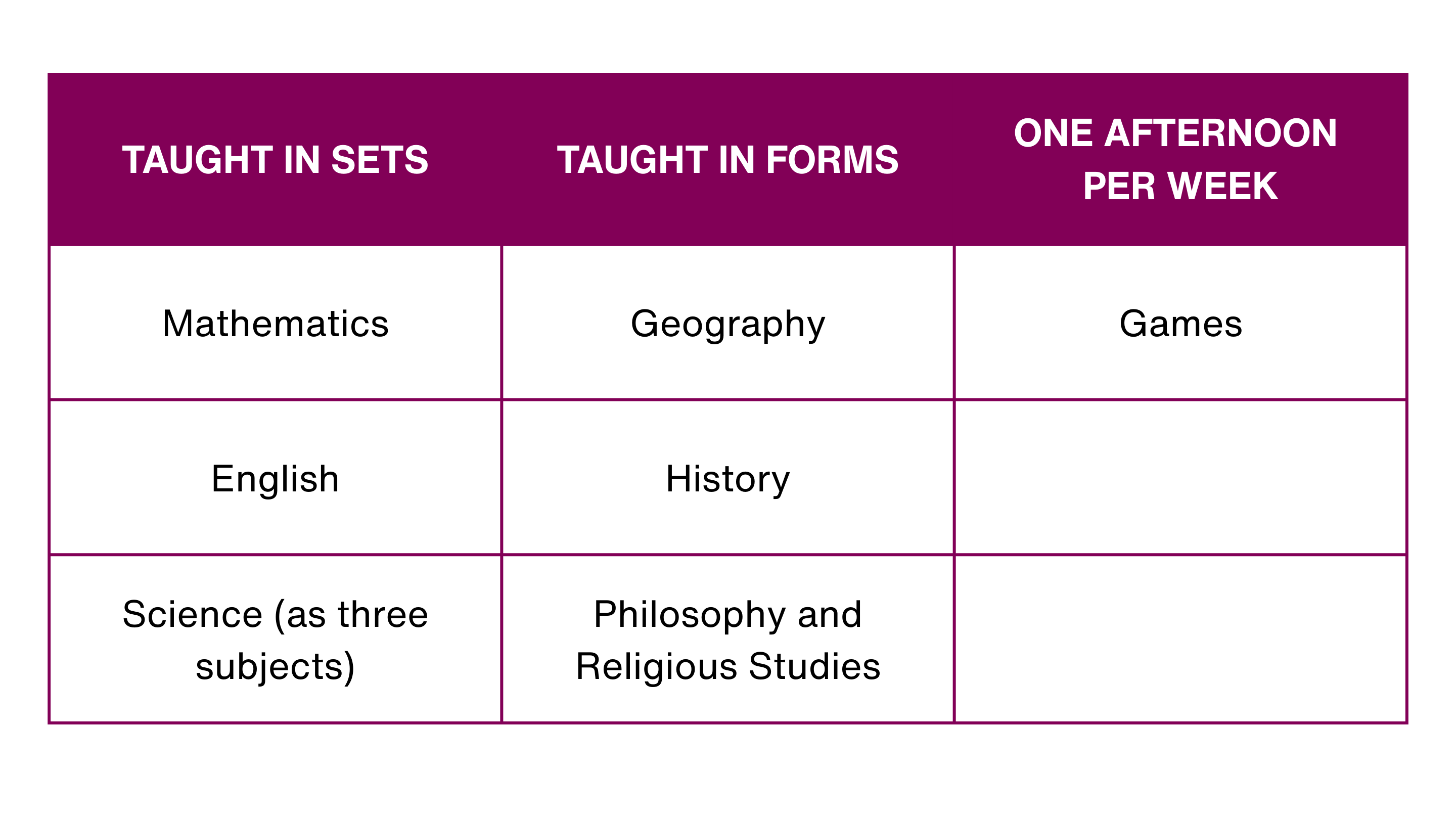
Options Curriculum
Pupils also have to study three of the following subjects: art, computing, design technology, drama, French, German, music and Spanish.
All students are expected to study at least one language subject*. Otherwise pupils are given a free choice of options subject. However, for timetabling purposes, pupils are asked to choose four subjects in order of priority; where possible pupils will be given their preferred choice, but this cannot be guaranteed.
In making their choices pupils should consider their ability in each subject and whether they are likely to wish to continue with a subject to GCSE. If a pupil wishes to study computing, French, German or Spanish at GCSE it is essential they choose these subjects in Year 9, and it is recommended that they do so for design technology.
*Pupils already attending the Learning Support Unit may opt not to choose a language in Year 9.
Options Choices
The process of choosing Year 9 options subjects begins in the Spring Term of Year 8, with the issuing of the Year 9 Curriculum Guide, which contains descriptions of all the options subjects. Pupils will have an assembly about the options available before making a choice of options subjects in consultation with their parents/guardians.
Pupils and/or their parents can make an appointment to see one of the careers staff if they feel that they would benefit from additional help to make the option choices.
Academic and Pastoral Monitoring
Academic monitoring is carried out in the first instance by the subject teachers and heads of each department. The year head is kept informed of all progress and has a detailed knowledge of the achievements of every child in this area of the school.
A full written report will be issued twice a year, with interim reports issued on two further occasions. Reports can be accessed via Firefly. End of year examinations will take place in the summer term.
Pastoral and disciplinary matters are also the concern of the head of year. Any parent who wishes to discuss his or her child should, in the first instance, contact his/her head of year.
Attendance Details
Any request for leave from school should be addressed to the Headmaster. If a pupil is absent from school through illness we ask the parents to inform the school by telephone immediately. In the case of a protracted absence, please contact the head of year.
Pastoral and disciplinary matters are also the concern of the head of year. Any parent who wishes to discuss his or her child should, in the first instance, contact his/her head of year.
Bring Your Own Device (BYOD)
From September 2024 there has been an expectation that students bring a computing device into school to support their work in lessons, as already occurs in the older year groups. This follows the Bring-Your-Own-Device (BYOD) model.
BYOD FAQs
The information below provides answers to common questions and explains why the Bring Your Own Device (BYOD) programme is important for our Year 9 students and above.
Why does the school have BYOD for Year 9 and above?
What will students use their devices for?
How will the school support students and parents?
What software will students need?
What type of device is suitable?
– Physical keyboard
– Lightweight
– Long battery life
– Ability to run necessary apps
– Protective case
– 8GB memory ideal (4GB sufficient)
– Windows/Chrome/MacOS acceptable
– Tablet + keyboard + stylus acceptable
– Headphones for multimedia
What rules apply to device use at school?
Students are expected to keep devices secure and arrive in school each morning with a fully-charged device. All students may utilise a locker; this should be kept locked when not in use.
Important: Device Insurance
What if parents or students have questions?
Our Subjects
Art and Design
The aims of the Art & Design department for Year 9 are:
• To build on the positive experiences of Art and Design from Years 7 and 8.
• To use artistic expression in order to communicate in visual and tactile ways.
• To further develop creative and technical skills so that pupils can produce artefacts and realise their own ideas.
• To develop pupils’ confidence and competence in reading and evaluating visual images and artefacts, as well as developing their enthusiasm about art and design and to encourage their capacity to enjoy art within society.
• To introduce students to a variety of skills and techniques which will be needed at the start of GCSE
Organisation
Groups are by option blocks in Year 9 and are mixed ability. At present there are four art groups, which are split between two members of staff.
Teaching Methods
All work is practical, although an understanding of the works of other artists, craftspeople and designers is encouraged through video, presentation and personal study. Students are taught how to analyse art works and to discuss them using the correct terminology. Work is in two and three dimensions and includes drawing, painting, collage, sculpture, ceramics, digital and mixed media. Each term students look at a theme / area of study or specific technique and develop their own work in response to the starting point, with guidance and teaching from the art department staff.
Topics Covered
• Pop Art Portraits
Students will develop their knowledge and understanding of the Pop Art movement with the work of Roy Lichtenstein and Andy Warhol being the main inspiration of their work. They will develop a range of skills that will lead to an outcome of a Pop Art self-portrait.
• Personal Project (own choice) – to prepare for GCSE
This project encourages the students to work more independently to create a portfolio of work on a theme of their choice. This scheme of work is structured similarly to the GCSE course to allow students to understand the expectations and requirements at GCSE level.
Progression
Within the department we use the first three years of teaching as a foundation course in the skills and expectations required at GCSE level. In Year 9 we use a working method that leads directly into the type of practical work expected by EDUQAS, the exam board we use for art and design GCSE. This allows students to start the GCSE course with confidence as they adopt a familiar approach to making practical work.
Extra Costs
Extra costs are charged after opting for Art & Design in Year 9 depending on the materials chosen by students for their projects, usually up to about £25 for the largest canvas size.
Computing
The Year 9 computing curriculum is designed to challenge students and develop and extend their computing and IT knowledge and experience from Years 7 and 8. Additionally, students will be introduced to some of the concepts for the optional GCSE Computer Science course at Years 10 and 11.
Organisation
Groups are mixed ability.
Teaching Methods
The course will be a mixture of theory work (both in class and for homework) and hands-on practice, but with greater emphasis on the practical. Teaching is by specialist staff with back-up from the ICT technicians.
Topics Covered
• Cybersecurity, including potential threats to networks and computer systems, and methods of protecting against them.
• Data Science and ‘big data’.
• Creating 3D models and animations using Blender.
• Developing coding skills using the BBC micro:bit
• Building on their Year 8 text programming and developing sequencing with Python.
• Creating and editing digital media using GIMP graphics design software and Audacity audio editing software
Progression
The Year 9 course leads to an optional GCSE in Computer Science in Years 10 and 11 as offered by OCR. It is highly recommended that the computing option is taken in Year 9 if the GCSE is to be chosen. The Year 9 course has been designed to introduce students to some key areas which will be studied in further detail at GCSE. Further opportunity for study within the department is offered in the sixth form with an A-level course in Computer Science, offering a chance to learn a programming language in far more depth and go into more detail about how computers work.
Design and Technology
The aims of the Design and Technology course in Year 9 are
• To develop, to broaden and to build upon the basic course in Years 7 and 8.
• To develop further a knowledge of materials and processes
• To broaden an enquiring approach to design
• To develop further the communication skills necessary for effective design folder work.
Organisation
Groups are mixed ability; each group will cover the two main material areas of wood and metal/plastics for half the year in each area/project. They will complete a design folder and practical piece of work in each area.
Teaching Methods
Each group will have a mixture of lessons for design development and practical work, and also taught lessons for technology theory, including theory based prep tasks.
Topics Covered
These will include: -
Workshop Safety
Design and Communication Skills
Properties of Wood, Metal and Plastics
Measuring and Marking Out of Materials
Shaping and Joining of Materials
Fixings and Fittings
Finishing of Materials.
CAD/CAM technologies and machinery
Progression
The Practical experience and Technology specific knowledge and understanding built up during Year 9 will form an essential basis for the GCSE Design and Technology course followed in Years 10 and 11. This GCSE Design and Technology Course is taken with the AQA Examination Board.
The use of ICT is encouraged throughout the course and in particular the use of CAD/CAM and realisation of practical work using these new technologies
Extra Costs
Students are expected to pay for the materials used in their practical projects which will obviously go home when completed and marked.
The cost of the materials used by individual pupils is added to their account at the end of term.
Drama
The Year 9 drama course aims to provide creative and academic challenge whilst celebrating the joys of both creating and experiencing live theatre. Throughout the course of Year 9, pupils will improve their understanding of people and the world around them by exploring situations that differ from our everyday experiences. During the course, students develop their analytical and evaluative skills and the knowledge of how drama and theatre is created and performed, including embedding and extending their subject specific terminology for all aspects of theatre. Students may elect to be assessed as either a performer, designer or chose a combination of the two.
Organisation
Pupils are taught in mixed ability option groups. Lessons are mainly practical and are based in either the Drama Studio or the McCarthy Theatre; however pupils should also expect regular classroom-based lessons where drama theory will be embedded in order to support their practical work and develop their academic writing.
Teaching Methods
This is a course with a balance of practical and written work, where students develop their skills as a performer, designer, creator and evaluator, in order to set a strong foundation for GCSE.
Assessment is on-going throughout the course and pupils are awarded a grade at the end of each project which can be measured against their Challenge Grade to assess their progress. The pupils will also complete an end-of-year exam which introduces pupils to the type of short and long answer questions, based on texts, that they will experience at GCSE. The questions interrogate their understanding of how to perform and design theatrical performances.
Topics Covered
Throughout the course, students will explore a range of texts, contexts and performance styles to broaden their understanding of drama and theatre. In the Autumn Term, students study devising through the theme of “The Seven Deadly Sins”. Students will use this theme as a stimulus to create visually striking performances and experiment with Berkoff’s physicality and Frantic Assembly’s physical theatre techniques. In the Spring Term, pupils will study a monologue for performance, focusing on the style of naturalism. For this unit, they may be assessed as either a performer or as designer (lighting, sound, or set and props). Pupils will then develop their understanding of how to approach a set text in drama, through exploration of the play “The Curious Incident of the Dog in the Night-Time” which they will study from the perspective of a performer and a designer. During the course of Year 9, students will also have the opportunity to visit the theatre to see a live performance, which will be used to support and develop their evaluative writing style.
Progression
The Year 9 course consolidates the skills and understanding of drama conventions already covered in Years 7 and 8, and also extends their knowledge and understanding of a range of techniques. Pupils joining the school can be reassured that all the necessary techniques are revisited and revised within the Year 9 option. Pupils will again be covering topics/themes and drama conventions of a more challenging nature. Pupils will practise their evaluative skills as a progression into GCSE. A certain amount of individual work will be required.
English
The English language and literature course in Year 9 has a number of aims. Firstly, we equip pupils with the fundamental skills they require to tackle the IGCSE course with confidence. Secondly, we continue the formal development of their awareness of language and their accuracy in spelling and grammar. Thirdly, we seek to foster an enjoyment of studying English, developing creativity and reading widely.
Organisation
Pupils are taught in sets according to ability. Close links with the SEN department ensure that students with particular needs receive specialist support.
Teaching Methods
In English a variety of teaching methods are used. These include teacher-led lessons, pupil presentations, small group work, drama, collaborative and individual writing, research and ICT work. We also believe in independent learning. Consequently, in the autumn term a period a week is set aside so that each pupil can write a detailed project about an issue, hobby, sport etc. that they particularly enjoy.
Topics Covered
Students will read around the topics of ‘Justice’, ‘Outsiders’ and ‘Survival’ as part of our thematic curriculum, through which they will read prose, drama (including Shakespeare), poetry, media and non-fiction texts from a range of eras. They will learn how to use quotations in essays, develop their ability to interpret texts and write for different audiences with a number of different purposes.
Progression
The Year 9 course lays the foundations for IGCSE level courses in both English language and English literature. The department believes that by acquiring these skills in Year 9, pupils grow in confidence and maturity.
Consequently, the leap from Year 9 to Year 10 is not as disarming as it could be.
French, German and Spanish
• To develop pupils’ ability to understand and use spoken and written French, German or Spanish.
• To increase knowledge of the structure of the language(s).
• To increase knowledge of French, German or Spanish culture.
• To provide a firm foundation for study of language at GCSE level.
Organisation
All Year 9 work builds on the work covered in Years 7&8.
Teaching Methods
We work from modern online text books (Dynamo, Stimmt, Viva) and we adopt an active approach in which pupils learn to communicate through a wide variety of activities, developing skills that are required at GCSE level.
Pupils are encouraged to use the target language as much as possible and have regular sessions with our foreign language assistants throughout Year 9.
The course books encourage pupils to revise and check their progress; there are regular end of topic tests and exposure to key GCSE skills. Grammar topics are covered in greater depth and we expect pupils to acquire a good understanding of verbs and grammar structures together with a wider range of vocabulary from which to tackle GCSE level work.
The new GCSE from September 2024 places greater emphasis on sound-symbol correspondence so dictation and reading aloud skills are also developed.
Topics Covered
French:
Sport & sporting heroes
Directions
Extra-curricular activities
Describing friends & birthday celebrations
Clothes
Musical tastes now vs in the past
Primary school descriptions
The francophone world: countries you would like to visit
Celebrity culture: francophone people
German:
Holidays
TV viewing habits
Healthy living (food/lifestyles)
School trip (daily routine/directions)
Arranging to go out & opinions
Spanish:
Holidays
Food/Drink
Jobs, careers & future plans
Clothes
Daily routine
Parts of the body/illness
Progression
The topics and skills covered in Year 9 are developed in greater depth in Years 10 and 11 thus ensuring a logical progression to the AQA GCSE Modern Languages exams.
Geography
The geography department aims to broaden geographical knowledge and global awareness by exploring a diverse range of places, environments, and contemporary issues, helping students understand the physical and human processes shaping the world and their role within it.
Organisation
Pupils are taught in mixed ability form groups by subject specialists.
Teaching Methods
The structure of the course is modular with units designed to fit roughly into half-term teaching packages. The course is able to meet the needs of different ability levels with a strong emphasis placed on enquiry learning: pupils are encouraged to involve themselves in investigative work and to ask questions and seek answers.
Essential ICT skills, map reading, graph drawing and atlas work, tested recall sections, evaluations and judgements within debates and discussions all add to the variety of teaching approaches and techniques used in Year 9. The internet, DVDs and interactive whiteboards are additional audio-visual stimuli used to support our teaching of geography as a ‘living subject’
Topics Covered
• Urban Issues and Challenges – sustainable cities
• The Challenge of Natural Hazards – tectonic hazards
• The Challenge of Resource and Management – food, water and energy
• Physical Landscapes in the UK – rivers
• Fieldwork opportunity
• The Living World – ecosystems and tropical rainforests
Progression
The year 9 geography course introduces students to GCSE-style themes, concepts and processes whilst building readiness and confidence by familiarising students with GCSE question types, geographical terminology, and independent enquiry.
History
Aims
History in Year 9 is primarily inspired by a wish to give individual pupils an understanding of their past and of society. History has a duty to ensure that individuals and society have ‘self-knowledge’ – that they have historical memory and are able to understand the past and hence not only have a partial grasp of the present.
We aim to stimulate interest in history through the use of enquiry and imagination and to create an awareness and understanding of what life in the past was like. History teaches a number of valuable skills including the clear expression of logical argument, relevant selection of material, fair assessment of character and the ability to see change and continuity over time.
We hope to stimulate an interest in and enthusiasm for the study of the past in preparation for GCSE and the pursuit of personal interest. We aim to develop the ability to understand interpretations of history and to produce a broad and balanced Year 9 curriculum suitable to the needs and interests of the pupils.
Organisation
All Year 9 pupils are taught in their form sets and are taught by one of three teachers.
Teaching Methods
A variety of teaching methods are used in history focusing on two key principles: the development of knowledge and skills. The knowledge rich curriculum is delivered by experts in history. This is underpinned with knowledge organisers, knowledge quizzes and the development of what events happened. All of our lessons develop this knowledge into explanations and analysis. Students are encouraged to use second order concepts to develop their answers, using terminology such as significance, cause and consequence, continuity and change. All students are assessed regularly with the opportunity to act on feedback given to show clear progression throughout the year.
We aim to further develop student understanding of ICT in preparation for the increased use of this at GCSE. Pupils complete a project whereby they research an area of interest from WW1. This could include a range of topics from Conditions in the Trenches, Weapons of WW1 and Life for Women in the War amongst others, as well as being a study of a family member if a student has their own personal knowledge and information to draw on. A visit to the WW1 battlefields in Belgium and France (Term 2) occurs annually. In the upper school we visit Auschwitz and Berlin on rotation which supports the history curriculum for Yrs 9-13.
Topics Covered
Term 1
The British Empire: this looks at the expansion of the Empire, as we focus on the slave trade and case studies of countries such as India, Australia and the USA. Students are also invited to form a conclusion about how we should view Empire, indeed should we apologise for it? This leads into our studies of The First World War. What life was like for soldiers and civilians in WW1 and how WW1 came to an end.
Term 2
Life in Nazi Germany. Students will focus on what life was like living in a dictatorship. This will include aspects of the treatment of the Jews in the 1930s. Studying Hitler’s foreign policy will take us into the Home Front and the Second World War. The Second World War topic will start in term 2 and continue into term 3.
Term 3
WW2 where we focus on the Home Front. What was life like for the British people, with a focus on evacuees, gas masks and the Blitz Spirit. We are also going to assess the experience of the German Home front and how they dealt with British and American bombing raids. This will culminate with the Holocaust and how it was carried out. To conclude our studies, we will learn about The New Elizabethans. This is a study of the reign of Elizabeth II through a social context. The content will develop how life changed throughout Elizabeth’s reign. This includes migration, The Beatles, the decline of British industry and the birth of new ones such as technology and inventors like Sinclair and Dyson. This will take us to 2022 with the death of The Queen.
Progression
The Year 9 history course continues the chronological approach pupils have studied in the lower school. In Year 9, particularly in terms 2 and 3, pupils will cover key aspects of the 20th century which will be particularly advantageous to GCSE history. History is an excellent subject for GCSE. It helps students understand the origins of modern political and social problems, developing skills to look beyond the headlines, to ask questions properly and to express their own opinions. The Year 9 course has been specifically designed to introduce students to key areas which will be studied in further detail at GCSE.
Extra Costs
The trip to the WW1 battlefields is optional, with preference given to those intending to study the subject at GCSE.
Mathematics
All students study a three year IGCSE mathematics course across Years 9-11. During Year 9 the scheme of learning consists of a series of modules which lay the foundations in number, shape and algebra so that these topics can be reviewed and studied in greater depth during Years 10 and 11.
Organisation
The year group is taught in five or six sets which are ordered by ability although all students study a common core of topics. Students in higher sets will deal with topics in greater depth while students in lower sets will take more time to cover the material key to preparing for IGCSE.
Teaching Methods
The main course text books are those published by CGP: Key Stage 3 book 3 with some exercises from the IGCSE textbook. The department operates in a traditional manner involving whole class teaching together with routine exercises and occasional investigational work; technology is used to engage students, deepen understanding and personalise learning. Students have access to support and extension materials via Firefly and DrFrostMaths. Homework is set each week and will primarily reinforce and extend the work covered in class, but may also involve some preparation for future lessons. A balance is maintained between mental methods, written methods and the use of calculators. Numeracy and arithmetic will still be tested and encouraged in lessons to reinforce basic techniques and ideas. It is vital that students are properly equipped for lessons. Calculators are used where appropriate - an adequate calculator is necessary in all maths lessons. If buying a new calculator we recommend the CASIO FX-83GTCW, FX-85GTCW or, if likely to do maths/science A-level, FX-991 CW.
Progression
In Year 10 pupils will continue to study the Edexcel IGCSE maths course in order to sit it in the summer of Year 11. The IGCSE course consists of two papers, each two hours long; both papers allow the use of a calculator.
The most able students will have the opportunity to study topics in greater depth as well as being introduced to more advanced topics in Year 11. This allows them to sit the AQA Level 2 Certificate of Further Mathematics alongside IGCSE maths.
Music
In Music, pupils will develop:
• An interest and understanding of a wide range of musical experiences.
• Performance skills, communicating confidently to an audience as a soloist and within an ensemble.
• Composition and improvisation skills, creating original pieces of music.
• Music Technology skills, using a range of software and hardware.
• An understanding of how music is created, structured and notated.
Organisation
This course explores all three strands of music:
• Performance
• Composition
• Listening and appraising
Pupils are taught in full class groups, in smaller groups and given tutorial time supporting composition projects.
Topics Covered
Assessment is ongoing throughout the course and pupils are assessed on the following:
• The performance of a prepared solo performance
• An ensemble performance
• A set composition in a popular style
• Sequencing skills
• Listening skills covering Western classical 1650-1910 and African fusion music
Music Technology
Pupils use a range of industry-standard software, including:
• MuseScore
• Soundtrap
• Cubase/Logic
Progression
This course provides a strong foundation for GCSE Music. We currently follow the AQA GCSE Music specification. Pupils who have not taken Music in Year 9 may still opt for the GCSE Music course in Year 10, provided they are having instrumental, DJ or singing lessons.
At GCSE there is a time requirement of 4 minutes, including 1 minute of ensemble performance, so students are encouraged to play, learn and perform a varied repertoire.
PSHCE
Students will follow a series of lessons based around the three core themes recommended:
Health and Wellbeing
• How to maintain physical, mental, emotional and sexual health and wellbeing.
• How to manage transition.
• About parenthood and the consequence of teenage pregnancy.
• How to manage risks and stay safe.
• How to identify and access help, advice and support.
• How to make informed choices about drugs, alcohol and tobacco.
• Administering first aid.
• The role and influence of media on lifestyle.
Relationships
• How to develop and maintain a variety of health relationships within a range of social/cultural contexts including LGBTQ.
• How to recognise and manage emotions within a range of relationships.
• About the concept of consent
• About managing loss including bereavement, separation and divorce.
• How to recognise and respond to risky negative relationships including bullying and how to seek help.
• How to respect equality and diversity in relationships.
Living in the Wider World
• About rights and responsibilities
• How to make informed choices and be enterprising and ambitious
• How to develop team work and leadership skills and develop flexibility and resilience
• How to manage personal finance
• How to respect specified fundamental British Values
These topics all provide opportunities for the student to grow and develop as individuals. They learn to work and discuss in groups and as a whole class unit thereby listening to other people’s opinions and learning to work together.
Philosophy and Religious Studies
The Year 9 course is preparation for GCSE and the topics covered are taught in such a way as to encourage and develop the core skill of philosophical enquiry and enable pupils to think about issues in an informed manner. The aim of the subject is to address ethical and philosophical topics that are both interesting and stimulating, whilst also being related to the modern world. Pupils are then able to learn, reflect, discuss, and evaluate their own position in relation to the subject matter.
Organisation
Groups are taught in forms that are of mixed ability.
Teaching Methods
The department encourages the sharing of views through discussion and debate in a controlled, respectful and sensitive environment where all views are able to be expressed. Written work is important, with the Department using ICT and a variety of suitable topic-related documentary programmes in its teaching and learning on a regular basis. Prep is varied, from written work to small projects, both of which encourage research and independent learning.
Topics Covered
Ethical topics studied, including medical issues such as abortion and euthanasia. Other areas of exploration include British values and attitudes to crime and punishment, prejudice, war, marriage and divorce. Philosophical issues relating to our existence also challenge the pupils’ views on the important questions of evil and suffering, the Holocaust, examples of those who have made a stand against evil and suffering, the existence of God, terrorism, miracles, and the evidence for life after death.
Progression
At GCSE, Religious Studies is an optional subject. Those opting for the course will be taking the AQA Religious Studies syllabus A, which was introduced in September 2016. The new syllabus contains greater emphasis on the beliefs, teachings and practices of religion. The religions chosen for study are Judaism and Christianity, although the department is considering offering Buddhism as a possible alternative to Judaism.
Physical Education and Games
• to inspire lifelong engagement and participation in sport for all pupils – and understanding the importance of exercise and physical activity in contemporary lifestyles, irrespective of ability.
• to continue to challenge and develop experience and expertise in a number of activity areas.
• to challenge all pupils to be the best versions of themselves and strive for Regional and International success.
Organisation
Pupils are timetabled in 3 x 55 minute (single) periods of PE every two weeks and a 1 x 110 minute (double) Games lesson each week
Teaching Methods
The focus of the year 9 curriculum is to develop knowledge and understanding through a variety of activity areas. The learning outcomes change for the different activity types but include;
· Develop and refine advanced skills and techniques.
· Evaluate and improve performance levels
· Use of tactics and strategies within game situations
· Develop the use of theoretical knowledge and terminology.
There is scope here to use some ICT, with ergometers, heart rate monitors and fitness test protocols to show pupils how to maximize their performance.
Games
In the Autumn term our major sports are Rugby, Netball and Girls’ Football, in the Spring term they are Netball, Rugby sevens and Boys’ Football, and in the Summer term they are Athletics, Cricket and Tennis. We also offer competitive fixtures in Badminton, Basketball, Cross-Country, Swimming, Squash, Table tennis and Triathlon throughout the year.
All activities are taught during the double ‘Games afternoon’ period. The whole year group is timetabled for this and pupils are put into activity groups during these lessons. For those either not in School teams, or not wanting to take part in our major games, we give an opportunity to experience a range of activities through a sports carousel. Some of these include: Badminton, Basketball, Climbing, Fitness Suite, Yoga and Volleyball.
Teaching Methods
Our major sports practices take place during Games lessons, these are teacher led, pupils are challenged to continuously developed their individual and team skills, with the overall aim to increase performances.
Every lesson has a competitive element in it and pupils are continuously challenged to develop not only their fitness levels but also their tactical knowledge and understanding of the sport in preparation for competitive fixtures which take place mid-week and on weekends.
The sports carousel option has been designed to be pupil led, we challenge the pupils to develop and refine skills and techniques in a wide range of activities. It provides pupils with an opportunity to improve their fitness levels and enhance their mental wellbeing.
Science
Edexcel IGCSE
Aims
Science Double Award 4SD0
Introduction
In September, all Year 9 pupils will start studying IGCSE science. The year group is divided into two halves: within each half-year, there will be sets 1 to 3, based on individual performance in Year 8. The course is examined as a single tier and therefore all pupils will be taught the same content throughout the three year course. Towards the end of Year 9 all pupils will sit examinations; the results of these assessments, in conjunction with topic test scores, will be used to determine Year 10 sets.
Science IGCSEs are terminally assessed, with no resits of separate components allowed. There are three two-hour papers - one for each subject, which include a mix of question styles: multiple-choice questions, short answer questions, calculations and extended open-response questions. The content is topical and covers a breadth of themes. There are many required practicals to develop and cement investigation skills. There are no tiers of entry, so student grades are only limited by their own ability and work ethic.
Aims
• learn about unifying patterns and themes in science and use them in new and changing situations
• acquire knowledge and understanding of scientific facts, terminology, concepts, principles and practical techniques
• apply the principles and concepts of science, including those related to the applications of science, to different contexts
• evaluate scientific information, making judgements on the basis of this information
• appreciate the practical nature of science, developing experimental and investigative skills based on correct and safe laboratory techniques
• analyse, interpret, and evaluate data and experimental methods, drawing conclusions that are consistent with evidence from experimental activities and suggesting possible improvements and further investigations
• recognise the importance of accurate experimental work and reporting scientific methods in science
• select, organise, and present relevant information clearly and logically using appropriate vocabulary, definitions, and conventions
• develop a logical approach to problem solving in a wider context
Organisation
Pupils are in the same set for all three science subjects. Sets are arranged for the first time based on examination results in Year 8 and progress throughout the year. Sets are based on achievement across all three sciences, and are reviewed both continuously and after end of year examinations. Each of the three sciences are taught by subject specialists.
Teaching Methods
Experimental work is present in lessons as much as possible and with four well-stocked prep rooms and small classes, we can ensure students have a full and varied experience of practical skills and apparatus within their lessons. When a practical activity is not appropriate, teachers will use modelling to further students’ understanding of topics. Teachers use many online platforms to engage, support and assess students in their lessons and are embracing many new teaching ideas using ICT. Science students are made aware from an early stage how important a grasp of mathematical skills is to interpreting science investigations and they are given many opportunities to hone these. Students are able to use literacy in varied forms in their science lessons, as expressing ideas precisely will enable them to achieve in science. Students are given the opportunity to apply knowledge to real-world and current concepts and, wherever relevant, possible careers in science are discussed.
Support Materials and Assessment
The science department are keen to build on the advances made in the use of devices for teaching and learning. All students from Year 9 upwards are expected to have a device with them in every science lesson. Teachers use online simulations, quizzes and learning platforms, such as Firefly and Microsoft Teams, to share resources, curate notes, complete consolidation tasks and for mini assessments. Many students choose to keep all their notes online whereas some prefer to use their device alongside paper notes. Students are provided with a revision guide which comes with free online access.
The Learning Support Unit
Looking ahead to Years 10 and 11, pupils choose four options in addition to English, maths and science at GCSE. Learning support can be one of those options. Time is available, not only to work on prep, but to organise and consolidate class notes as well as building up revision notes. At appropriate times throughout the year, pupils will also look at study skills, revision and exam techniques to help with exam preparation. With staff agreement, permission can be sought to go to specialist rooms, for example, art and DT. This further helps with the idea of ‘keep up and catch up’ that is ever present in learning support.
As well as support with subject matters, there is also time to consider future plans, post-16. Should academic A-levels not be the most appropriate option, we are able to advise pupils of local opportunities for vocational courses and apprenticeships. In short, we provide flexible support and welcome space in a busy and demanding school life.
Further details of our work can be obtained by contacting a member of the Learning Support Department.
Further Questions and Enquiries
For all questions and enquiries pertaining to our Year 9 Curriculum, please contact one of our Senior Leadership Team listed below who will be able to assist further:
Mr A Cadman – Deputy Head (Pastoral)
cadman.am@woodhousegrove.co.uk
Mr E Wright – Deputy Head (Academic)
wright.ej@woodhousegrove.co.uk
Mr C Softley – Assistant Head (Sixth Form and Futures)
softley.cl@woodhousegrove.co.uk