
Sixth Form Handbook 2026
Explore this section
Find Your Future
Sixth Form life is very different to school from Years 7 to 11.
And The Sixth Form at Woodhouse Grove is very different to Years 12 and 13 at any other school.
We help our pupils work out where they want to go and then help them get there. Our forward thinking, flexible approach utilises 3 programmes that work in unison, ensuring that every student, whatever their strengths and aspirations – whether these be academic and University focused or more vocational in nature – is offered the teaching, training and opportunities to best achieve their goals and excel out in the real world.
Here’s how it works:

Pathway Tutorial Programme
Tutor groups are determined by students’ future career aspirations, led by a Form Tutor who has specialist knowledge in that field. As such, forms are a mix of Y12 and Y13 pupils, in order to foster conversations about careers and futures from the moment a student begins at The Grove.
In this way, our Sixth Formers are offered in depth knowledge into relevant future career paths on a weekly basis – supporting their studies and providing invaluable information for interviews and the workplace.
Find Your Future

Find Your Future
PSHCE and Life Skills Programme
This focuses on teaching our pupils the life skills they will require once they leave Woodhouse Grove – and includes exposure to some of the challenges they will face in later life.
All our Sixth Form pupils take part in fortnightly sessions. Some of these are delivered to the whole year group but others are more bespoke, catering to specific career fields or can be signed up to by the pupil.
Find Your Calling

Find Your Calling
Partnership Programme
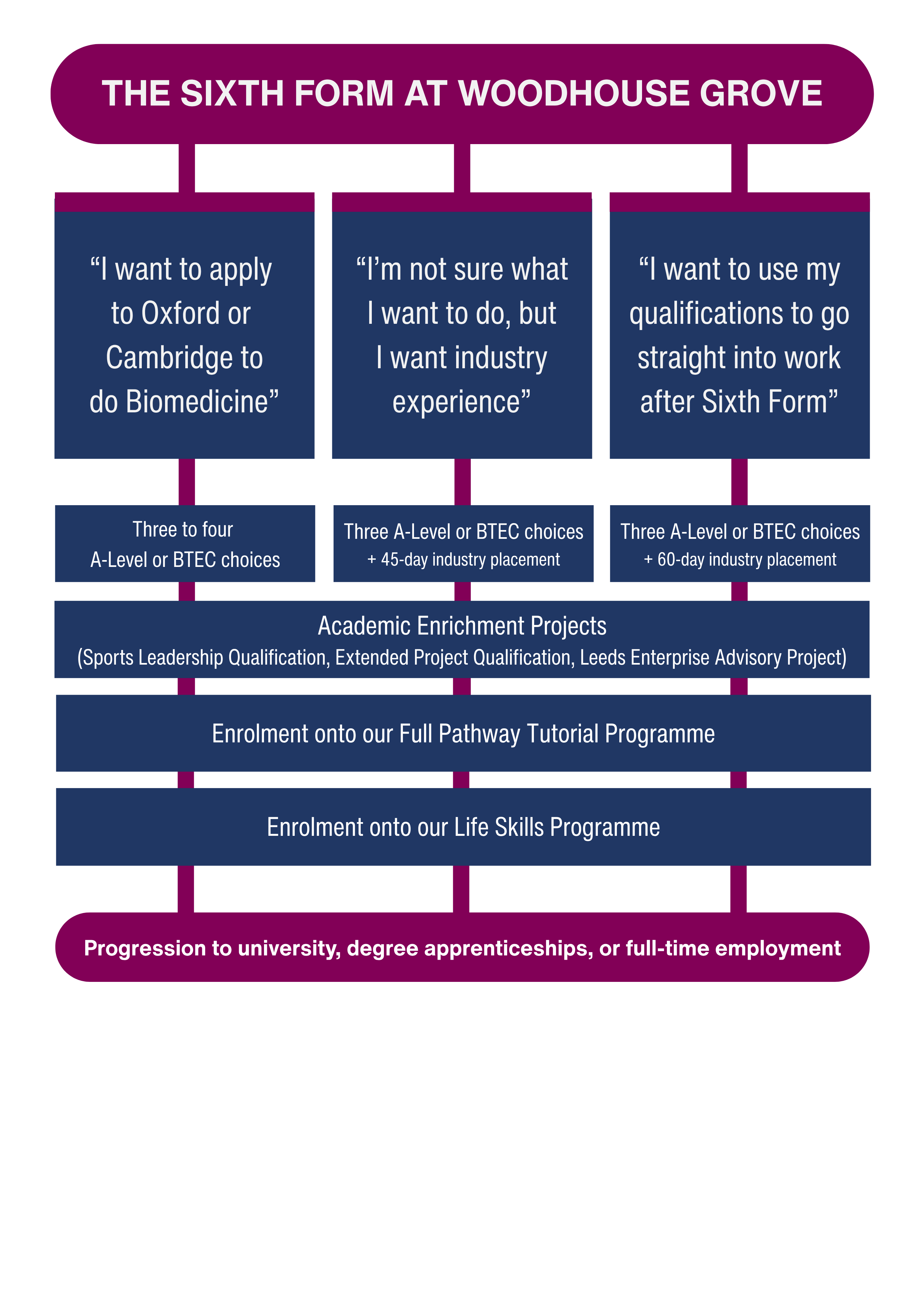
Our Sixth Form Partnership Programme gives students a competitive edge by developing workplace-ready skills whilst still at school. Through meaningful placements with our business partners (ranging from 30-60 days per year) students gain the kind of hands-on experience that makes CVs stand out from the crowd.
Flexible arrangements work around studies, with placements tailored to each student’s interests following an initial interview. Whether it’s week-long blocks, regular day visits, or a mix of both, every placement is carefully designed to engage and encourage the student in their chosen career path.
The result? Students who don’t just learn about careers, they experience them, building genuine skills and confidence for whatever comes next, whether that’s university, an apprenticeship, or stepping straight into their chosen field.
An Innovative Approach
We are very aware that each student has their own set of aspirations and career-goals. As such, we cater each students’ journey through Sixth Form by targeting their desired destination, whether that be University, an Apprenticeship or Degree Apprenticeship, or going straight into full-time employment.
We are all too aware of the rising crisis within entry-level employment post-university which often require candidates to have industry experience prior to their employment, which can be hard to achieve while studying full-time in Higher Education.
To combat this, we tailor students’ Sixth Form journeys, ensuring students are offered real-world experiences and industry insights from the moment they enter the Sixth Form:
Decide your life's direction

Decide your life's direction
Subject Choices
Year 12 students can study up to four subjects, this number depends on which pathway they choose to take.
For students picking four subjects, we will do our best to accommodate as many choices as possible when writing the timetable; however there is a chance that some combinations may not be possible.
Pick your type of Sixth Form

Pick your type of Sixth Form
Co-Curricular and Enrichment
When a student joins us in Year 12, they are presented with two co-curricular options: Games (such as Rugby or Netball), or Community Service.
Students may also take part in enrichment opportunities, which may form part of their chosen pathway. These specific options often lead to formal qualifications, such as the Extended Project Qualification, which is formally recognised by universities and may potentially lead to a reduced entrance offer.
To view our extensive co-curricular programme, click below:
Co-Curricular Activities
Subject Options
These subjects will run in the 26/27 academic year. While we strive to maintain all subjects, there is the possibility this list may change due to teacher availability and student interest.
Creative Arts
Art and Design
What will I study?
Our A-Level Art and Design course aims to build the essential knowledge and skills needed to develop accomplished, high quality art work.
The students will start by exploring a range of techniques and media during a term’s ‘Foundation’ style course before deciding on a personal theme which they will explore using all their acquired knowledge and skills. They will look at the work of artists and craftspeople, from the past and the present and will make large scale work in both 2D and 3D, generating a diverse and exciting portfolio of work.
How does it work?
Each group is taught by two members of staff, who will oversee practical demonstrations. Students conduct their own practical investigations before participating in group discussions and one-to-one tutorials with their teacher. We also offer individual action-plan sessions and lectures which emulate undergraduate study.
Students are encouraged to visit a wide-range of galleries and museums which will enrich and support their studies.
Students will also be encouraged to take part in life-drawing sessions with live models, which allows the students the opportunity to develop their life drawing skills of the human form.
How will I be assessed?
The 2 year A-level consists of two components:
1. An extended personal project (60%)
2. An externally set exam started in February of the second year. (40%)
The units are marked using 4 assessment criteria:
(AO1) Contextual Understanding
(AO2) Experimentation
(AO3) Researching / Recording
(AO4) Personal Response
Students will have the option of taking AS Art and Design at the end of the first or second year of the two year course as an alternative to the full A-level.
Design and Technology
What will I study?
Our Design and Technology course encourages independent learning, creativity and innovation, while also allowing students to appreciate the complex relationships between design, materials, manufacture, and marketing.
How does it work?
The practical Design and Make projects develop student's understanding of and ability to use a variety of materials, processes, and techniques.
Background reading and study should include visits to exhibitions and critical observations of products the student finds interesting, which will inform discussions that influence the student's design work.
The course requires the application of maths and science skills with a high quality of theory content.
Visits to local industries, museums and designer outlets help to broaden our students’ perspective on designs past and present and on industrial production techniques.
How will I be assessed?
Component 1: Principles of Design and Technology (50% of the A-Level)
Written Exam: 2½ hours
Component 2: Independent Design and Make Project (50% of the A-Level)
Non-examination assessment. Students will research, design, and then create their own project, which will then be assessed based on set Assessment Objectives.
The cost of the materials used by individual students is added to their bill at the end of term.
Drama and Theatre
What will I study?
Our Drama and Theatre course offers a balance between practical theatre-making and the theoretical understanding of drama and theatre.
This stimulating and engaging course of study encourages learners to make connections between dramatic theory and their own practice.
How does it work?
Learners study five performance texts which span a range of social, historical, and cultural contexts. Key extracts from these texts are studies for performance.
Learners also produce three performances: a devised performance, a creative reinterpretation of an extract from the text, and a scripted piece.
Theory is studied in order to prepare learners for the written and practical elements of the assessments.
The course involves several theatre trips to see as much theatre as possible in a variety of diverse styles, and the opportunity for students to work with professionals and to interview them in Q&A sessions.
Our theatre trips typically cost within the range of £20-£35 per performance.
How will I be assessed?
Component 1: Theatre Workshop (20%)
Internally assessed, externally moderated performance.
Component 2: Text in Action (40%)
Externally examined live performance.
Component 3: Text in Performance (40%)
Written examination.
Why Drama and Theatre?
The skills developed at A-Level lend themselves to many undergraduate courses, such as English, Production Management, TV and Film, Live Events Management, and Teaching.
Transferable skills include:
Powers of analysis, evaluative skills, presentation skills, communication, and teamwork.
Music
What will I study?
This course prepares students prepares students for further study, building on skills developed at GCSE level.
Students will develop knowledge of various musical theories and concepts, and will study a collection of prescribed works. They will also complete practical performances and build a portfolio, with a choice of repertoire chosen by the student and their instrument/vocal teacher.
How does it work?
Music classes are taught by all of the music staff, with a focus on independent practice as part of the course. Composition and set works are covered in tutorial style classes where students are expected to submit exercises, essays, short-answer questions, and conduct research.
Throughout the course students receive instruction in matters such as advanced harmony, various historical periods, and listening techniques.
There is an opportunity for students to attend concert trips, and study guides and musical scores will need to be purchased.
How will I be assessed?
Component 1: Appraising Music (40%)
Written examination with listening and analytic sections.
Component 2: Performance (35%)
Externally assessed solo and/or ensemble performance.
Component 3: Composition (25%)
Two externally assessed compositions.
Music Technology
What will I study?
Musical Technology is a practical based course with a focus on practice and refining skills.
Students will refine their knowledge of music software and hardware, and will become skilled in producing professional tracks in both live recording and programming sequencers using both existing recordings and original material.
This course is based entirely on popular music.
How does it work?
This course is mostly explored through hands-on practical tutorials; small group work is fundamental to the course as students learn the art of sound capture and production techniques.
Due to the large amount of practical assessment, lessons are often spent examining a technique and then using it to record or create tracks.
Lessons on the development of music technology will focus on both historical and current issues as well as listening and analysing a broad range of popular and jazz styles.
Students are expected to purchase a study guide which they will annotate during lessons, and will take part in a trip to a professional recording studio.
There is no requirement for students to possess a studio set up at home, although some form of elementary music technology set up is advisable for students to use in between lessons.
How will I be assessed?
Unit 1: Recording (20%)
Unit 2: Technology Based Composition (20%)
Unit 3: Listening and Analysis Exam (25%)
Unit 4: Production (Practical) exam (35%)
Component 3: Composition (25%)
Two externally assessed compositions.
Humanities
English Language
What will I study?
This course will help students develop understanding of how people communicate and create meaning, how language relates to social factors, psychology, power, and justice.
Topics will include accent and dialect, language and gender, the language of occupations, World Englishes, language change, and child language acquisition.
Students develop critical analysis skills and learn how to challenge assumptions, as well as how to apply ideas and theories to topical situations.
How does it work?
Students will have two teachers. Lessons consist of a range of activities, including discussion of theories and the application of theory to data.
Work, both in and out of the classroom, will consist of reading articles and studies, making notes, planning and writing a range of response types, presenting ideas, and collecting data.
How will I be assessed?
Paper 1: Language, the Individual, and Society (40%)
Written examination comprising of analysis of textual representation in two unseen texts, then data analysis of child language development.
Paper 2: Language, Diversity, and Change (40%)
Written exam comprising of a choice of essays on diversity or change, followed by an analytical response to an unseen text and a recreative writing task.
Coursework: Language in Action (20%)
Task 1: Language Investigation
Pupils will choose an area of language to investigate and will collect their own data.
Task 2: Original Writing
Pupils will submit a piece of original writing, an annotated style model, and a commentary.
English Literature
What will I study?
English Literature students will study a variety of texts including contemporary novels, poetry, drama, and Shakespeare.
Current texts include:
The Great Gatsby
Othello
A Doll's House
Students will also study a 'Modern Times' module, which focuses on modern literature's presentation of sociopolitical issues, such as The Handmaid's Tale and A Streetcar Named Desire
Independent Critical Study allows students the freedom to write a comparative critical study of two texts on a theme of their choice, emulating undergraduate study.
How does it work?
Lessons are taught by two members of the department and include: class discussions, presentations, annotation, independent research, and essay writing.
The course is more independent than at GCSE/iGCSE level, and students will be encouraged to respond individually to a range of texts.
How will I be assessed?
Unit 1: Love Through the Ages (40%)
Written examination covering three texts: one poetry, one prose, and one Shakespeare text.
Unit 2: Texts in Shared Contexts (40%)
Written examination covering three texts: one poetry, one prose, and one drama text.
Unit 3: Independent Critical Study (20%)
Written Coursework comprising of one comparative essay.
Students will be charged for their own copies of the texts they study. The department will provide examination copies. Students are also offered the opportunity to see any relevant theatre productions.
History
What will I study?
History at A-Level aims to develop the knowledge and understanding of people and events, and seeks to work out how these have impacted on society then and in the present day.
Students will focus on historical events from the 18th to the 20th century.
How does it work?
Students will be taught by two teachers, and will be responsible for note-taking, participation in discussion and debate, individual research, analysis of sources and peer assessment.
Students will be exposed to undergraduate teaching methods through lectures and kinaesthetic teaching methods.
The only costs to be incurred on this course is the educational international trip, such as a visit to Auschwitz or Berlin.
How will I be assessed?
Component 1: Breadth Study (40%)
Britain 1783-1885: Industrialisation and the People
Component 2: Depth Study (40%)
Democracy and Nazism: 1918-1945
Component 3: Historical Investigation (20%)
Coursework based on a set topic.
Geography
What will I study?
Students will engage with topics which assess the relationship between human populations and their physical environment.
This course will ask students to consider their own roles, values, and attitudes in relation to the discussed themes and issues, and the roles, values, attitudes of others, including decision-makers.
How does it work?
A variety of teaching and learning styles will be used, typically taught by three teachers specialising in separate topics.
Students will engage with online materials to support their teacher-led learning, and take part in class discussions and data analysis. They will also be required to complete independent research and analysis.
How will I be assessed?
Component 1: Physical Geography (40%)
Written examination on the following topics: water and carbon cycles; coastal systems and landscapes; hazards.
Component 2: Human Geography (40%)
Written examination on the following topics: global systems and global governance; changing places; changing urban environments.
Component 3: Geographical Investigation (20%)
Students complete an individual investigation relating to any part of the specification, which must include data collection in the field. The question or issue is to be decided by the student.
There is a requirement to undertake 4 days of fieldwork throughout the course, which may be all or partly residential and will incur an additional cost. This is to allow students to prepare for the geographical investigation component.
Philosophy
What will I study?
This philosophy specification asks these questions:
What can we know?
How do we make moral decisions?
Can the existence of God be proved?
Are my mind and body separate?
These questions form the basis of philosophical enquiry. The material covered in the specification not only provides students with understanding of how these debates have (so far) been framed, but also acts as a springboard for consideration and discussion of students' own ideas.
How does it work?
Pupils will be taught through teacher-led sessions and independent study. Various media sources will inform discussions. Students will conduct independent research and participate in small group sessions which will form part of examination preparation.
Students will need to read and become familiar with key philosophical texts, philosophical vocabulary and a high level of literacy.
How will I be assessed?
Paper 1: 3 hour written examination
Section A: Epistemology
Section B: Moral Philosophy
Paper 2: 3 hour written examination
Section A: Metaphysics of God
Section B: Metaphysics of Mind
GCSE Religious Studies is not required to study philosophy at A-level
Government and Politics
What will I study?
This course examines the way that the UK is governed, and the participation of citizens in that process, with an inclusion of global issues which puts the UK into a worldwide context.
The main focus of the first two components is British politics. Students will learn about all aspects of the state, the nature of democracy, the role of the media, and the core political ideas which have shaped the UK's political landscape.
The third component focuses on global politics.
Students do not need any prior knowledge of politics, but must have an interest in current affairs and political issues.
How does it work?
Teaching is shared between two teachers. Written work is compulsory and students will be taught exam technique and key vocabulary.
Discussion is also central to teaching as a way of developing students' ideas and confidence.
There is an optional but popular day-trip to the Houses of Parliament which usually costs around £50 per student.
How will I be assessed?
Three equally weighted exam papers covering all topic areas.
Component 1: UK Politics
Focuses on the key elements of the British political system and core beliefs.
Component 2: UK Government
Focuses on the roles of the various institutions of the state.
Component 3: Comparative Politics
Focuses on politics on a global level examining the different issues and perspectives.
There is no coursework for this course.
Media Studies
What will I study?
This course explores a range of contemporary forms of mass communication such as TV drama, music videos, video games, advertising and film marketing, newspapers and magazines, and online and social media.
Students will develop their understanding of the values and messages within the media, and how media products are constructed and by who. Students will also gather knowledge of media representation, and how audiences consume, use, and respond to different media.
The course combines theoretical exploration and analysis with practice, and students will develop a range of technical skills throughout the course as they explore and produce their own media products.
How does it work?
Lessons will include critical discussions, presentations, annotations, and deconstructions of a range of media texts, theoretical exploration, debates, and essay writing.
The course shares a lot of skills with English as you explore the meaning and messages which are encoded in media products that consume every day.
How will I be assessed?
Three equally weighted exam papers covering all topic areas.
Component 1: Exam (35%)
Evaluation of advertising and marketing, music videos, radio, newspapers, film, and one unseen media product.
Component 2: Exam (35%)
Evaluation of television, magazines, online and social media, video games, and one unseen media product.
Non-exam Assessment (NEA): Creating cross-media production (30%)
Students select a brief set by AQA and create a cross-platform response.
Sports and Performance
BTEC Sport
What will I study?
Everyone taking this course will study three mandatory units, covering the mandatory content areas:
1. Anatomy and physiology.
2. Fitness training and programming for health, sport, and well-being.
3. Professional development in the sports industry.
In addition, students can choose one optional unit that advances their chosen career path. These optional units cover the following content:
1. Application of fitness testing
2. Sports Psychology
3. Practical Sports Performance
4. Sports Leadership
How does it work?
Students will be expected to complete lecture-style notes during teacher-led learning. They will also partake in class discussions, analyse and evaluate data, create individual and group presentations, and complete a series of past papers.
Students will also be given the opportunity to visit a local University to carry out performance and fitness analysis.
Regular performance in at least one sport is advised.
How will I be assessed?
A mixture of assessment formats over the course of two academic years.
Year 12:
Three internal assignments, and one 90-minute formal external exam focused on Anatomy and Physiology.
Year 13:
Three internal assignments, and one 2.5 hour formal external exam focused on a fitness training case study.
Level 3 Sports Leadership Qualification
What will I study?
Students will progress through 6 units which will enable them to be proactive and engaging leaders. Students will learn how to lead safe sporting activities, how to plan and execute these activities, and how to be an inclusive sports coach.
How does it work?
Students will attend a weekly theoretical session during the 18 months of the programme which will enable them to complete the relevant content.
Students will then volunteer to undertake their leadership practical assessments during their free lessons and/or after-school activities. Students are required to complete their Learner Evidence Records (LERs) as well as having formal observations and feedback from teachers supporting them in their sessions.
How will I be assessed?
Students will complete a blend of written work, such as completing their Learner Evidence Record and task worksheets, and 14 hours of practical demonstration of leadership capabilities. Practical demonstration is broken down into a 2-hour demonstration of Event Leadership, and the leading of sport activities equivalent to 12 hours.
Commerce and Enterprise
Business
What will I study?
This course provides students with an excellent grounding in the fundamentals of business. It allows them to get an idea of how the whole business functions together, whilst also allowing them to look in more detail at specific areas of the organisation.
At the core of the course is decision-making, and how this is used to improve the performance of four functional areas: marketing, operations management, financial, and human resources. The course shifts towards a focus on strategy in Year 13.
How does it work?
Students will be expected to complete lecture-style notes during teacher-led learning. They will also partake in class discussions, analyse and evaluate data, create individual and group presentations, and complete a series of past papers.
All of our teachers are specialists with industry experience.
How will I be assessed?
Three equally weighted exam papers covering all topic areas. Paper 2 includes data-response questions and Paper 3 includes a compulsory case study.
There is no coursework for this course.
Students will have the option of taking AS Business at the end of the two-year course as an alternative to the full A-Level.
Economics
What will I study?
This course aims to develop understanding of economic theories through a critical consideration of current economics issues, problems, and institutions that effect everyday life.
Students will apply economic concepts and theories in a range of contexts which aim to give them an appreciation of real world phenomena.
The student will also analyse and evaluate the strengths and weaknesses of the market economy, and the role of government in it.
The recommended requirements for Economics A-Level are a Grade 7 in GCSE Maths, and Grade 6 in GCSE English Language.
How does it work?
Students will be expected to complete lecture-style notes during teacher-led learning. They will also partake in class discussions, analyse and evaluate data, create individual and group presentations, and complete a series of past papers.
How will I be assessed?
Three equally weighted exam papers covering all topic areas.
Paper 1: Markets and Market Failure
(Microeconomics)
Paper 2: National and International Economics
(Macroeconomics)
Paper 3: Economic Principles and Issues
There is no coursework for this course.
Students will have the option of taking AS Economics at the end of the two-year course as an alternative to the full A-Level.
BTEC Enterprise and Entrepreneurship
What will I study?
This course allows candidates to develop an understanding and appreciation of the factors that lead to successful entrepreneurs and enterprises.
Areas of study include marketing, business, personal finance, and entrepreneurs themselves.
Visits to local businesses are an essential part of the course; we also expect to arrange talks from entrepreneurs.
Access to a local business would be useful in helping to carry out research. However, support will be provided to facilitate this.
How does it work?
Students will be expected to complete lecture-style notes during teacher-led learning. They will also partake in practical investigations (research into local businesses and entrepreneurs), group discussions, individual research, and oral presentations.
Mandatory Units
Enterprise and Entrepreneurs
Developing a Marketing Plan
Personal and Business Finance
Optional Units
Social Enterprise
Entrepreneurship and Intrapreneurship
How will I be assessed?
There are 2 internally assessed units, followed by 1 set assignment and 1 written exam.
This approach provides students with the opportunity to showcase to employers their practical experience.
Languages
German
What will I study?
Our A-Level German course aims to build the essential knowledge and skills needed to communicate in German, whether in speech or writing. It also provides an insight into the structure of the language and into the culture of the German-speaking world.
Students study a wide variety of material in German, including magazine articles, television programmes, songs, films, and literature.
How does it work?
Lessons are delivered as much as possible in German, but not exclusively.
Students will partake in class discussions, complete individual research and exercises, and practice their reading, translation, and writing abilities throughout the course. There will be regular access to the language lab, and digital resources provided. Students are expected to be willing to work in groups and with the German Language Assistant.
A visit to a German-speaking country would be helpful for this course, but not compulsory.
How will I be assessed?
Paper 1 (40%):
Written exam testing listening, reading, and translation skills.
Paper 2 (30%):
Written exam. Students will write two essays, in German, on literature and visual media studied during the course.
Paper 3 (30%):
Speaking examination, comprising discussion of a stimulus card and of an individual research project carried out by the student.
Students will have the option of taking AS German at the end of the second year of the two year course as an alternative to the full A-level.
Spanish
What will I study?
Our A-Level Spanish course aims to build the essential knowledge and skills needed to communicate in Spanish, whether in speech or writing. It also provides an insight into the structure of the language and into the culture of the Spanish-speaking world.
Students study a wide variety of material in Spanish, including magazine articles, television programmes, songs, films, and literature.
How does it work?
Lessons are delivered as much as possible in Spanish, but not exclusively.
Students will partake in class discussions, complete individual research and exercises, and practice their reading, translation, and writing abilities throughout the course. There will be regular access to the language lab, and digital resources provided. Students are expected to be willing to work in groups and with the Spanish Language Assistant.
A visit to a Spanish-speaking country would be helpful for this course, but not compulsory.
How will I be assessed?
Paper 1 (40%):
Written exam testing listening, reading, and translation skills.
Paper 2 (30%):
Written exam. Students will write two essays, in Spanish, on literature and visual media studied during the course.
Paper 3 (30%):
Speaking examination, comprising discussion of a stimulus card and of an individual research project carried out by the student.
Students will have the option of taking AS Spanish at the end of the second year of the two year course as an alternative to the full A-level.
French
What will I study?
Our A-Level French course aims to build the essential knowledge and skills needed to communicate in French, whether in speech or writing. It also provides an insight into the structure of the language and into the culture of the French-speaking world.
Students study a wide variety of material in French, including magazine articles, television programmes, songs, films, and literature.
How does it work?
Lessons are delivered as much as possible in French, but not exclusively.
Students will partake in class discussions, complete individual research and exercises, and practice their reading, translation, and writing abilities throughout the course. There will be regular access to the language lab, and digital resources provided. Students are expected to be willing to work in groups and with the French Language Assistant.
A visit to a French-speaking country would be helpful for this course, but not compulsory.
How will I be assessed?
Paper 1 (40%):
Written exam testing listening, reading, and translation skills.
Paper 2 (30%):
Written exam. Students will write two essays, in French, on literature and visual media studied during the course.
Paper 3 (30%):
Speaking examination, comprising discussion of a stimulus card and of an individual research project carried out by the student.
Students will have the option of taking AS French at the end of the second year of the two year course as an alternative to the full A-level.
Mathematics, Science, and Psychology
Biology
What will I study?
Our A-Level Biology course aims to build essential knowledge and understanding of the ideas and skills of biology, and how the practice of science and technological advancements have progressed this field.
Students will study the cells, molecules, and systems which make up living organisms, how they interact with each other and their environment, and how variation is introduced.
The course requires good literacy, numeracy, interpretative skills, and critical thinking. 15% of all marks are for investigative skill assessed questions and 10% for numeracy skills.
How does it work?
Lessons are planned with the understanding that students will use a device to take lecture-style notes, and make use of digital study tools.
Students are also expected to partake in class discussions, group and independent research tasks, practical investigations, and complete practice papers. Each set is taught by two teachers with content split amongst the two teaching staff.
Students are expected to attend a field course at the beginning of Year 13 at the Cranedale Centre. This currently costs in the region of £300.
How will I be assessed?
Paper 1 (35%):
Written exam.
Content: cells, molecules, exchanges, and variation.
Paper 2 (35%):
Written exam.
Content: Energy transfers, responses, genetics, and gene mutation.
Paper 3 (30%):
Written exam.
All content covered, with focus on investigative, numeracy, and literacy skills.
Students will have the option of taking AS Biology at the end of the second year of the two year course as an alternative to the full A-level.
Chemistry
What will I study?
Our A-Level Chemistry course aims to build essential knowledge and understanding of the ideas and skills of chemistry, and how advances in information technology are used in this area of study.
Students will explore how chemistry has contributed to society, and how we use scientific knowledge and evidence responsibly.
How does it work?
Students are taught by two members of staff. Practical lessons run to support the practical element of assessment, students will complete at least 12 practicals over the course of the two years.
The remaining lessons cover the theoretical framework necessary for study of Chemistry, and will require students to partake in lecture-style note taking, problem solving exercises, and completing practice papers.
How will I be assessed?
Paper 1 (35%):
Written exam.
Content: physical and inorganic chemistry.
Paper 2 (35%):
Written exam.
Content: physical and organic chemistry.
Paper 3 (30%):
Written exam.
All content covered.
Students will have the option of taking AS Chemistry at the end of the second year of the two year course as an alternative to the full A-level.
Computer Science
What will I study?
Thinking computationally is an important life skill. The course looks at how a computer works and how to get the best from it and covers a range of topical areas of study.
The course covers:
• Internal computer components
• Cyber security
• Data representation
• Effect of digital technology on society
• Programming
• Networking and the Internet
• Software development
The course has a mathematical element and students are expected to be precise in their definitions and explanations. It would be beneficial, but not essential, to have studied the subject at GCSE.
How does it work?
Study for the non‐exam assessment and for parts of Paper 1 is very practical, students will use both Python and Lua programming software. This will be largely self‐paced learning.
Study for the theoretical aspects of Paper 1 and Paper 2 is completed through a variety of teaching methods including a flipped classroom approach and self-research. The specification looks at how computers store and manipulate data, encryption techniques, details about networking, the Internet and how data can be stored and manipulated.
How will I be assessed?
Paper 1 (40%):
2.5 hour on-screen exam.
Content: Theory and Programming
Paper 2 (40%):
2.5 hour written exam.
Non-Exam Assessment (20%):
Students solve or investigate a chosen practical problem, for example programming a database, or creating a game.
Students will have the option of taking AS Computer Science at the end of the second year of the two year course as an alternative to the full A-level.
Physics
What will I study?
Our A-Level Chemistry course aims to build essential knowledge and understanding of the ideas and skills of classical and modern physics, providing insight into the underlying forces which determine the behaviour of the universe.
A-Level Physics covers topics such as: subatomic particles, quantum physics, kinematics, dynamics, electricity, nuclear physics, and heat engines.
How does it work?
Students are taught by two members of staff, with classes determined by their other subject choices. Each topic taught is followed by homework relevant to this learning. Once a topic has been covered, examination questions are completed by students and marked by their teacher.
Past papers will be used to tailor learning, and practicals are used as a way to feed into learning and assist in practical-focused questions on exam papers.
How will I be assessed?
Paper 1 (34%):
Written exam.
Content: Particles, waves, mechanics, and electricity.
Paper 2 (34%):
Written exam.
Content: thermal physics, fields, and nuclear physics.
Paper 3 (32%):
Written exam.
Practical skills, data analysis, and an option topic selected by the student.
Maths
What will I study?
A-level Maths is split into pure and applied sections. Pure maths builds on and considerably extends the number and algebra work covered in the higher tier GCSE/IGCSE course and also incorporates integration. Applied maths uses these pure skills in mechanics and statistical contexts.
Mathematics develops problem solving and analytical skills; mathematicians are valued for their ability to work methodically and carefully and also for their creativity and ability to apply ideas to new situations and problems.
How does it work?
Teaching will be a mixture of discussion, notes and examples, as well as regular opportunities to solve problems and prove results. Exercises on each topic will be set and marked regularly; it is by means of these exercises together with thorough and continuous learning of new material that most of a student’s learning takes place.
In statistics, pupils will be taught many of the required techniques with reference to a large data set and use of technology is encouraged to make this process more efficient.
How will I be assessed?
Paper 1: Pure Mathematics 1
2 hours, 100 marks.
Paper 2: Pure Mathematics 2
2 hours, 100 marks
Paper 3: Statistics and Mechanics
2 hours, 100 marks
A calculator is allowed in all three papers.
Students are provided with their own textbook and access to online materials, but will need to purchase the Casio FX-991EX enhanced scientific calculator.
Further Maths
What will I study?
Further Mathematics extends the work covered by A-Level Mathematics. It is intended for students who find the required study for A-Level Mathematics relatively straightforward, and has desire to take their studies to a more rigorous level.
How does it work?
Teaching will be a mixture of discussion, notes and examples, as well as regular opportunities to solve problems and prove results. Exercises on each topic will be set and marked regularly; it is by means of these exercises together with thorough and continuous learning of new material that most of a student’s learning takes place.
Students are given opportunities to use technology such as graphical calculators and online software to develop their understanding.
Students are also encouraged to participate in the UKMT senior team, and individual maths challenge competitions.
How will I be assessed?
(Each exam is made up of 75 marks over 90 minutes)
Paper 1: Core Pure Mathematics 1
Paper 2: Core Pure Mathematics 2
Paper 3: Further Maths Option 1
Paper 4: Further Maths Option 2
Students are taught three of the following option topics:
Further Pure
Further Mechanics
Further Statistics
Decision Mathematics
Psychology
What will I study?
This course provides a broad introduction to Psychology as an academic and medical science, with more than a passing nod to it's roots in philosophy.
Six key approaches are covered: psychodynamic, behavioural, cognitive, evolutionary, social, and biological. These perspectives are applied in a range of practical scenarios, from memory and mental illness, to relationships, gender, and conformity.
There is also a strong emphasis on the empirical methods psychologists use in research.
How does it work?
Students will be expected to complete lecture-style notes during teacher-led learning. They will also partake in class discussions, analyse and evaluate data, create individual and group presentations, and complete a series of past papers.
Students will also get the opportunity to design and take part in their own experiments.
How will I be assessed?
Three equally weighted exam papers covering all topic areas.
Paper 1: Introductory Topics in Psychology
Paper 2: Psychology in Context
Paper 3: Issues and Options in Psychology
There is no coursework for this course.
Students will have the option of taking AS Psychology at the end of the two-year course as an alternative to the full A-Level.
Extension and Enrichment Options
These qualifications are either recognised by UCAS and can contribute to university applications, or provide students with practical experience that can be evidenced in entry-level employment applications.
Extended Project Qualification
How does it work?
Students complete an independent research project on a question of their own choice. The project involves the completion of a 5000 word essay or 1000 words plus an artefact, emulating the undergraduate dissertation writing process.
The course begins midway through Year 12. Students are given lessons on a variety of skills that will be required to complete the qualification – e.g. presentation, researching, and referencing.
Each student is appointed a staff supervisor with whom they meet at regular intervals to review progress.
How will I be assessed?
Assessment is through the production of a research log, a presentation, the research project itself and a review. The qualification gives UCAS points up to A*, equivalent to half an A-level.
Leeds Enterprise Advisory Project (LEAP)
From choosing the company’s name and logo, to producing the products and selling them; the students even get to keep the profit. Students work in teams, and will have support and advice from link tutors with business experience to help them on their way.
This option is particularly useful for business and economics students but is open to all.
How will I be assessed?
There is no formal assessment, as such; the businesses will be assessed under a number of criteria. These include: most profit, most innovative product and most thorough administration, with the prospect of winning prizes.
ESOL for Overseas Students
Students without GCSE English may need to sit the IELTS exam in order to enter university. Preparation classes are arranged around the students’ timetable and they focus on the four skills of reading, writing, listening and speaking as well as increasing vocabulary.
The course equips students with the range of academic language needed to succeed in further education. Overseas students are also encouraged to sit A-levels in their home language. This earns the student extra UCAS points when applying for university.
How does it work?
ESOL lessons cost £10 per lesson when in a small group and £26 when opting for one to one. The IELTS exam costs about £210.
How will I be assessed?
The IELTS exam can be taken as often as needed and results take up to two weeks to be returned. It consists of a one hour reading exam, a one hour writing exam, a forty minute listening exam and a fifteen minute speaking exam.
Elective Games
Students may choose a games option or a community service option at the start of each term and will need appropriate PE kit.
Optional Sixth Form games kit is available from Grays Team Sport, details can be found on the uniform section of our website.
Current Games Activities:
Rugby Swimming
Rugby Sevens Handball
Netball Cross Country
Basketball Athletics
Cricket Climbing
Football Badminton
Tennis Fitness (in the Gym)
Squash Community Service
Senior fixtures and Tournaments:
These are occasionally played on Wednesday afternoons during the games sessions, and on Saturdays across a range of sports and activities.
We see Saturday fixtures as a key element of the school’s co-curriculum and there is an expectation to represent the school on a Saturday if selected.
Find Your Calling
Find Your Calling
Learning Support
At Sixth Form level, there are no formal lessons taught in the Learning Support Unit, but staff are still available for consultation. Support may be arranged by cross-referencing pupil free periods with staff timetables.
If you are joining The Sixth Form at The Grove and had any exam concessions at GCSE (e.g. extra time, rest breaks, reader, word processor use) it is very important that you make early contact with Miss Monk, Head of Learning Support. Such pupils (new or existing) will need updated evidence to establish if concessions are still appropriate. We have in-house tests to support such applications.
Pick your type of Sixth Form
Pick your type of Sixth Form
Independent Study
Sixth Form students have Private Study time which can be spent in our specialist Sixth Form facilities: the Sixth Form Centre, where they have access to Woody’s Cafe, or the Sixth Form Building with state-of-the-art study spaces and private seminar rooms for group work.
Independent study time in the Sixth Form Centre and Building is supervised, and assistance is given by subject teachers and the Sixth Form staff in Year 12 to prepare students to effectively manage their time and make use of these study sessions.
The Sixth Form Building and Sixth Form Centre provides private study space for both Year 12 and Year 13 away from the rest of the school. These areas are usually open from 7:30am to 6:00pm, and both feature private study spaces and social learning areas.
Helpful Information
Dress Code
Colours blazers are awarded to students who demonstrate exceptionally in either an academic or co-curricular capacity and can be worn in place of a jacket.
Girls
Jacket
A smart, business-like jacket.
Skirt
A dress or formal trousers as part of a suit. The skirt or dress must be of sufficient length to preserve modesty, must not be figure-hugging (no lycra), and must be business-like in style and worn with a jacket. Neither jeans nor shorts may be worn.
Top
A smart top, but not a vest top.
Jumper
A smart jumper may be worn in addition to, but not in place of, a jacket.
Hoodies and sweatshirts are not permitted.
Shoes
Smart dark shoes. Boots are not permitted.
Boys
Suit
A smart, plain or pinstriped suit in a dark colour. The jacket and trousers must be made of the same material. (The material may not be jersey, denim, tweed or corduroy.)
Shirt
A shirt with a collar fastened at the neck, worn with a tie.
Jumper
A smart plain jumper may be worn in addition to, but not in place of, a jacket.
Hoodies and sweatshirts are not permitted.
Shoes
Smart dark shoes. Boots are not permitted. Trainer socks are not allowed.
Facial Hair
Students are expected to be clean shaven.
(Rare exceptions may be made relating to or on religious grounds, supported by appropriate confirmation)
Careers Advice
University Applications Process
Other information provided includes a handbook on types of universities and courses (entitled “After Sixth Form”), a handbook on how to complete the UCAS form, university entry requirements, dates of university open days and further careers information.
Year 12 are also taken to the Higher Education Fair at which every Higher Education establishment in the country has a stand. The Fair also features displays from potential future employers such as the Armed Forces, as well as many gap year organisations.
Individual support is provided with UCAS applications from specialist staff as well as interview practice and additional support with university admissions tests.
Helpful Links
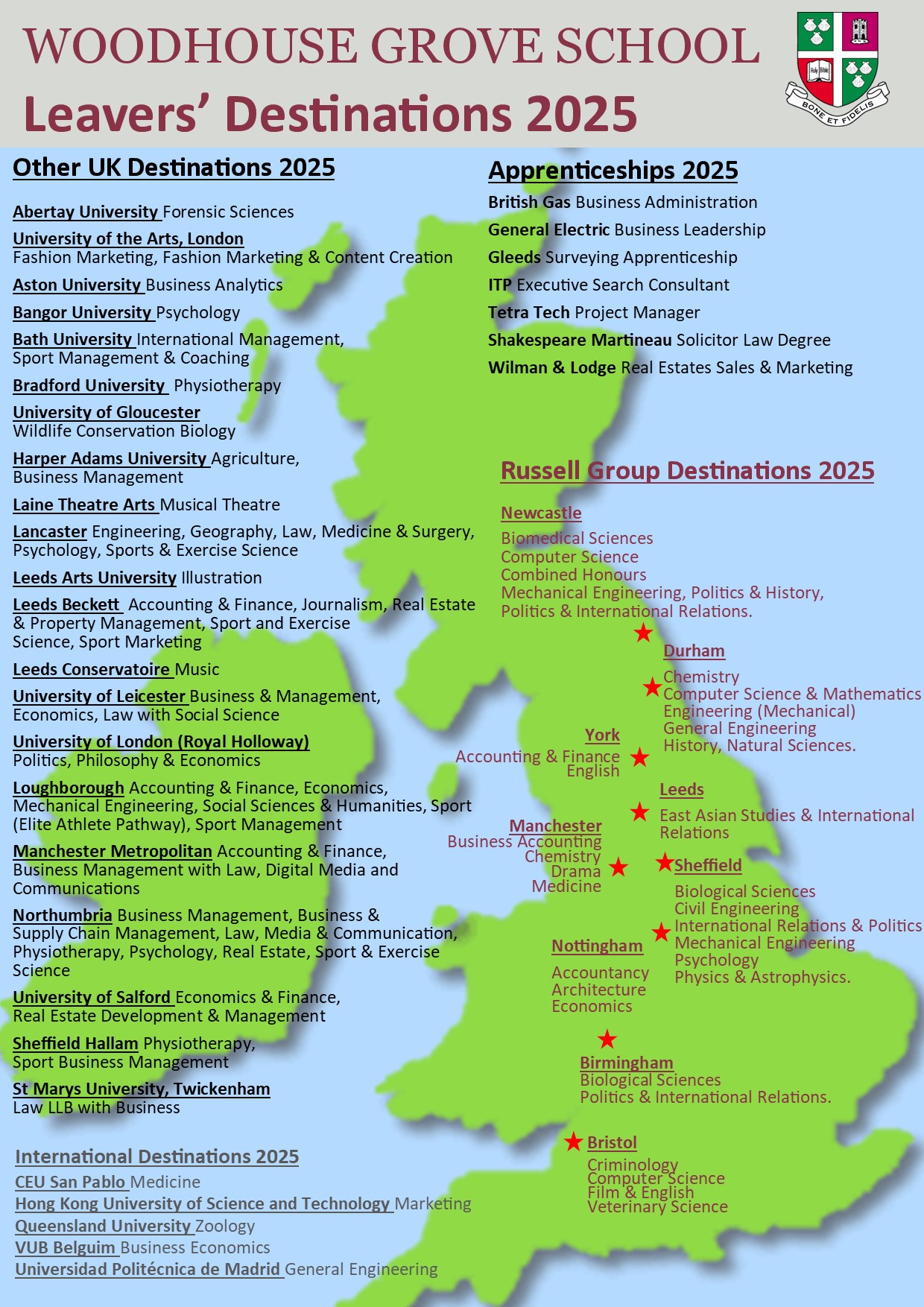
Leaver’s Destinations
Each year, we ask our students where they are heading after they leave The Grove. This year, our leavers are studying all over the UK and beyond, plus many exciting degree apprenticeships and training schemes.